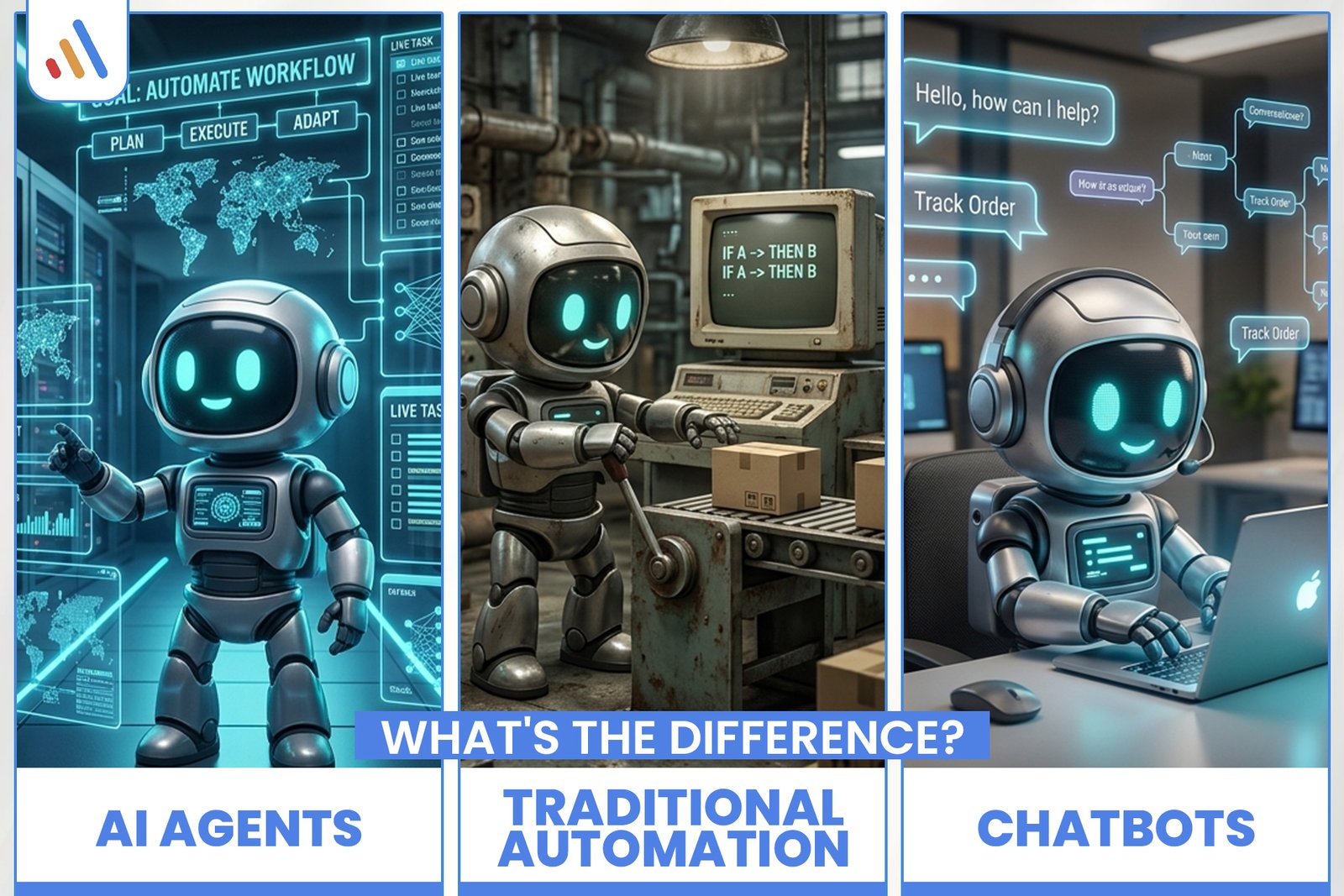
Artificial intelligence is changing how businesses interact with customers, manage workflows, and automate everyday operations. But as AI technology evolves, businesses now have more options than ever: traditional automation, chatbots, AI chatbots, AI automation, and autonomous AI agents.
The challenge is understanding which technology actually fits a specific business problem.Should you use a chatbot to answer customer questions? A traditional automation workflow to process repetitive tasks? Or an AI agent that can understand a goal, make decisions, use business systems, and complete multiple actions?
Understanding AI agents vs chatbots is especially important because these technologies can appear similar on the surface while performing very different jobs.
A chatbot may answer a customer’s question. Traditional automation may move information from one system to another. An AI agent can potentially understand the customer’s request, retrieve relevant information, make a decision, perform an action, and continue the workflow without requiring every step to be explicitly programmed.
This guide explains AI agents vs chatbots vs automation, how they differ, where each technology works best, and how businesses can decide which approach to implement.
What Are AI Agents?
An AI agent is an intelligent software system designed to understand objectives, reason through tasks, interact with tools or business systems, and take actions to achieve a defined goal.Unlike a basic chatbot that mainly responds to messages, an AI agent can be designed to perform tasks beyond conversation.
For example, imagine a customer says:
“I need to reschedule my appointment for next Tuesday.”
A basic chatbot may provide instructions explaining how to reschedule.An AI chatbot may understand the request and respond naturally.
An AI agent could go further by:
- Understanding the customer’s request
- Identifying the customer’s account
- Checking appointment availability
- Finding suitable times
- Rescheduling the appointment
- Updating the CRM
- Sending a confirmation message
The important difference is action.AI agents are designed not just to communicate, but to work toward an objective.
Businesses interested in building these types of systems can explore VCL’s AI Agent Development Services, which include customer service agents, sales and lead engagement agents, internal assistants, workflow automation, API integrations, CRM/ERP connectivity, and other agent capabilities.
What Are Chatbots?
Chatbots are software applications designed to communicate with users through text or sometimes voice.
Traditional chatbots typically operate using predefined rules, decision trees, scripted responses, or fixed conversation paths.
For example:
Customer: What are your business hours?
Chatbot: We are open Monday to Friday from 9 AM to 6 PM.
This works well when customers ask predictable questions.
Modern AI chatbots are more sophisticated. They can understand natural language, recognize context, generate responses, and handle a wider range of questions.
However, an AI chatbot is still primarily focused on conversation and assistance.This distinction is important when comparing AI agents vs AI chatbots.
An AI chatbot might explain how to cancel an order. An AI agent could potentially verify the order, check the cancellation policy, cancel the order, update the relevant system, and notify the customer.The technologies can overlap, but their responsibilities are different.
AI Chatbots vs Traditional Chatbots
One of the most common comparisons businesses make is AI chatbot vs traditional chatbot.Traditional chatbots generally rely on predefined rules.
For example:
User: I want to return my product.
Traditional chatbot: Select one of the following options:
- Track Order
- Return Product
- Contact Support
The system follows a predetermined flow.An AI chatbot can understand variations in natural language.
A customer might say:
“The shoes I ordered don’t fit. How can I send them back?”
Instead of requiring the customer to select a specific menu option, the AI chatbot can interpret the request and provide a relevant response.
Traditional Chatbot
- Rule-based
- Predetermined responses
- Limited flexibility
- Works well for simple FAQs
- Requires predefined conversation paths
- Best for predictable interactions
AI Chatbot
- Natural-language understanding
- More flexible conversations
- Can use contextual information
- Can answer complex questions
- Can work with knowledge bases
- Better suited for dynamic customer interactions
However, an AI chatbot does not automatically become an AI agent simply because it uses generative AI.
The key difference is whether the system can reason, use tools, make decisions, and execute actions toward a goal.
AI Agents vs Chatbots: Key Difference
The simplest way to understand AI agents vs chatbots is this:
A chatbot primarily communicates. An AI agent can communicate, reason, decide, and act.Consider a customer support example.
A chatbot may answer:
“Your order is currently being shipped.”
An AI agent could potentially:
- Retrieve the customer’s order
- Check the latest shipping information
- Identify a delivery delay
- Contact the shipping API
- Update the customer
- Create a support ticket if necessary
- Escalate the issue to a human employee
The agent is not simply answering a question. It is completing a workflow.
This makes AI agents particularly valuable for businesses where customer conversations are connected to operational processes.
What Is Traditional Automation?
Traditional automation has existed long before modern generative AI.It uses predefined rules and workflows to perform repetitive tasks automatically.
A basic workflow might look like:
New form submission → Add customer to CRM → Send email → Notify sales team
The system does not need to understand the meaning of the information deeply. It simply follows the instructions it has been programmed to follow.
Traditional automation is excellent when processes are:
- Predictable
- Repetitive
- Rule-based
- Structured
- Consistent
For example, if an invoice is approved, automatically send it to the accounting system.There is no need for an AI agent to perform a simple task that can be handled reliably by traditional automation.
AI Agents vs Traditional Automation
The comparison between AI agents vs traditional automation becomes clearer when we look at how each technology handles decisions.
Traditional automation typically follows:
If X happens → Do Y
AI-powered systems can handle situations where the input is less predictable.
For example, traditional automation might process a form with fixed fields.
An AI-powered system could analyze an email containing:
“We received the shipment, but several products were damaged and two items are missing.”
The system can interpret the unstructured message, identify the issues, extract relevant information, classify the request, and potentially trigger the appropriate workflow.That is where AI automation becomes valuable.Traditional automation is still extremely useful. It should not be viewed as outdated technology.
Instead:
Traditional automation is best for predictable processes.
AI automation is useful when processes require interpretation, context, or intelligent decision-making.
For a deeper comparison, see VCL’s guide to AI Automation vs Traditional Business Automation.
AI Agents vs AI Automation
Another important comparison is AI agents vs AI automation.
These terms are sometimes used interchangeably, but they are not exactly the same.AI automation generally means using artificial intelligence within automated business processes.
For example:
Email received → AI classifies request → Automation routes request → CRM is updated
An AI agent can be part of that system, but an agent generally has a higher degree of autonomy.An agent may receive a goal and determine the sequence of actions required to accomplish it.
For example:
Goal: Resolve a customer’s billing issue.
The agent could:
- Identify the customer
- Review account information
- Analyze billing history
- Determine the likely issue
- Check company policies
- Decide what action is appropriate
- Update the account
- Notify the customer
- Escalate the issue if required
The distinction is therefore not simply “AI versus automation.”It is about how much reasoning and autonomy the system has.
AI Agents vs Chatbots vs Traditional Automation
Here’s a simple comparison:
| Feature | Traditional Automation | Chatbot | AI Chatbot | AI Agent |
| Rule-based workflows | Yes | Yes | Sometimes | Sometimes |
| Natural-language understanding | Limited | Limited | Yes | Yes |
| Answers questions | No | Yes | Yes | Yes |
| Understands context | Limited | Limited | Stronger | Strong |
| Makes decisions | Rule-based | Limited | Limited | Yes |
| Uses external tools | Sometimes | Limited | Possible | Yes |
| Executes multi-step tasks | Limited | Rarely | Sometimes | Yes |
| Works toward a goal | No | Limited | Limited | Yes |
| CRM/API integration | Yes | Sometimes | Yes | Yes |
| Best for | Repetitive processes | FAQs | Intelligent conversations | Complex workflows |
The right technology depends on what you want the system to accomplish.
When Should a Business Use Traditional Automation?
Traditional automation is often the best option when the process is simple and predictable.
Examples include:
- Sending automated emails
- Moving data between systems
- Generating routine notifications
- Creating invoices after a completed transaction
- Updating records
- Assigning tasks
- Scheduling recurring reports
- Processing standardized forms
If the workflow can be accurately described using simple rules, traditional automation may be more efficient and easier to maintain.There is no reason to introduce complex AI into a process that does not require intelligence.
When Should a Business Use an AI Chatbot?
AI chatbots are particularly useful when businesses receive large numbers of customer questions.
Common use cases include:
- Customer support
- Product questions
- Service information
- Appointment assistance
- Frequently asked questions
- Website assistance
- Lead qualification
- Internal employee support
For example, an e-commerce business could use an AI chatbot to answer questions about products, shipping, returns, and availability.The chatbot can provide immediate assistance without requiring a customer service employee to answer every basic question.
When Should a Business Use AI Agents?
AI agents become more attractive when the process involves multiple steps, different systems, and decision-making.
Potential use cases include:
Customer Service
An agent can understand a customer’s problem, retrieve account information, troubleshoot the issue, and escalate when necessary.
Sales
AI agents can qualify leads, answer product questions, recommend solutions, schedule meetings, and update CRM records.
Operations
Agents can analyze requests, retrieve information from multiple systems, trigger workflows, and coordinate tasks.
Internal Business Assistance
Employees can use AI agents to search company information, summarize documents, generate reports, and complete repetitive operational tasks.
Finance
AI agents can assist with document processing, invoice workflows, financial information retrieval, and exception handling, with appropriate human controls.
How Businesses Can Combine All Three
Businesses do not necessarily have to choose one technology.
In many cases, the strongest architecture combines traditional automation, AI chatbots, and AI agents.
For example:
Customer sends message
↓
AI chatbot understands the request
↓
AI agent determines what needs to happen
↓
Traditional automation executes predictable steps
↓
Human employee handles exceptions
This hybrid approach can provide both intelligence and reliability.
For example, an AI agent may determine that a customer needs a refund.
Traditional automation can then execute the approved refund workflow automatically.
This combination allows each technology to do what it does best.
Why AI Integration Matters
Implementing AI successfully is not just about adding a chatbot to a website.
The real value often comes from connecting AI with the systems a business already uses.
These may include:
- CRM platforms
- ERP systems
- Databases
- APIs
- Websites
- Mobile applications
- Email systems
- Customer support platforms
- Internal knowledge bases
VCL’s Artificial Intelligence Integration Services focus on connecting AI capabilities with business workflows and creating more intelligent, automated processes.
For organizations that need a broader technology foundation, AI Software Development Services can also support custom AI applications, enterprise AI solutions, intelligent workflow automation, AI integrations, and AI-powered customer solutions.
How to Choose the Right Technology
Before investing in AI, ask five questions.
1. Is the Process Predictable?
If yes, traditional automation may be enough.
2. Does the User Need a Conversation?
If yes, an AI chatbot may be appropriate.
3. Does the System Need to Take Actions?
If yes, consider an AI agent or integrated automation workflow.
4. Does the Process Require Multiple Decisions?
Complex decision-making is a stronger use case for AI agents.
5. Does the Technology Need Access to Business Systems?
If the solution needs CRM, ERP, databases, APIs, or other systems, integration architecture becomes an important part of the project.
The goal should not be to use the most advanced technology available.
The goal should be to use the right level of intelligence for the problem.
The Future of Business Automation
The difference between automation, chatbots, and AI agents will likely become less visible as businesses build increasingly connected systems.
A customer may start with a simple conversation, but behind that conversation could be an AI agent retrieving information, making decisions, calling APIs, triggering traditional workflows, and coordinating multiple systems.This means businesses should think beyond standalone chatbots.
Instead, they should consider how AI can become part of their broader software and operational infrastructure.The organizations that benefit most will not necessarily be those that adopt the most AI tools.
They will be the businesses that identify the right processes, connect the right systems, establish appropriate human oversight, and measure whether AI is actually improving efficiency and customer experience.
Final Thoughts
The debate around AI agents vs chatbots is ultimately about capability and purpose.Traditional automation is excellent for predictable, rule-based processes.Traditional chatbots are useful for structured customer conversations.
AI chatbots provide more natural and flexible interactions.AI automation adds intelligence to business workflows.AI agents go further by combining understanding, reasoning, tool use, decision-making, and task execution.The best solution depends on the problem you are trying to solve.
If your business simply needs to answer common questions, an AI chatbot may be enough. If you need to automate a predictable workflow, traditional automation could be the better choice. But if your business needs a system that can understand objectives, work across multiple systems, make decisions, and complete multi-step tasks, AI agents may provide significantly greater value.
The key is not choosing AI because it is the latest technology.The key is choosing the technology that creates measurable business value.