Businesses have been using automation for years to reduce repetitive work, speed up operations, and improve consistency. But the rise of artificial intelligence is changing what automation can accomplish.
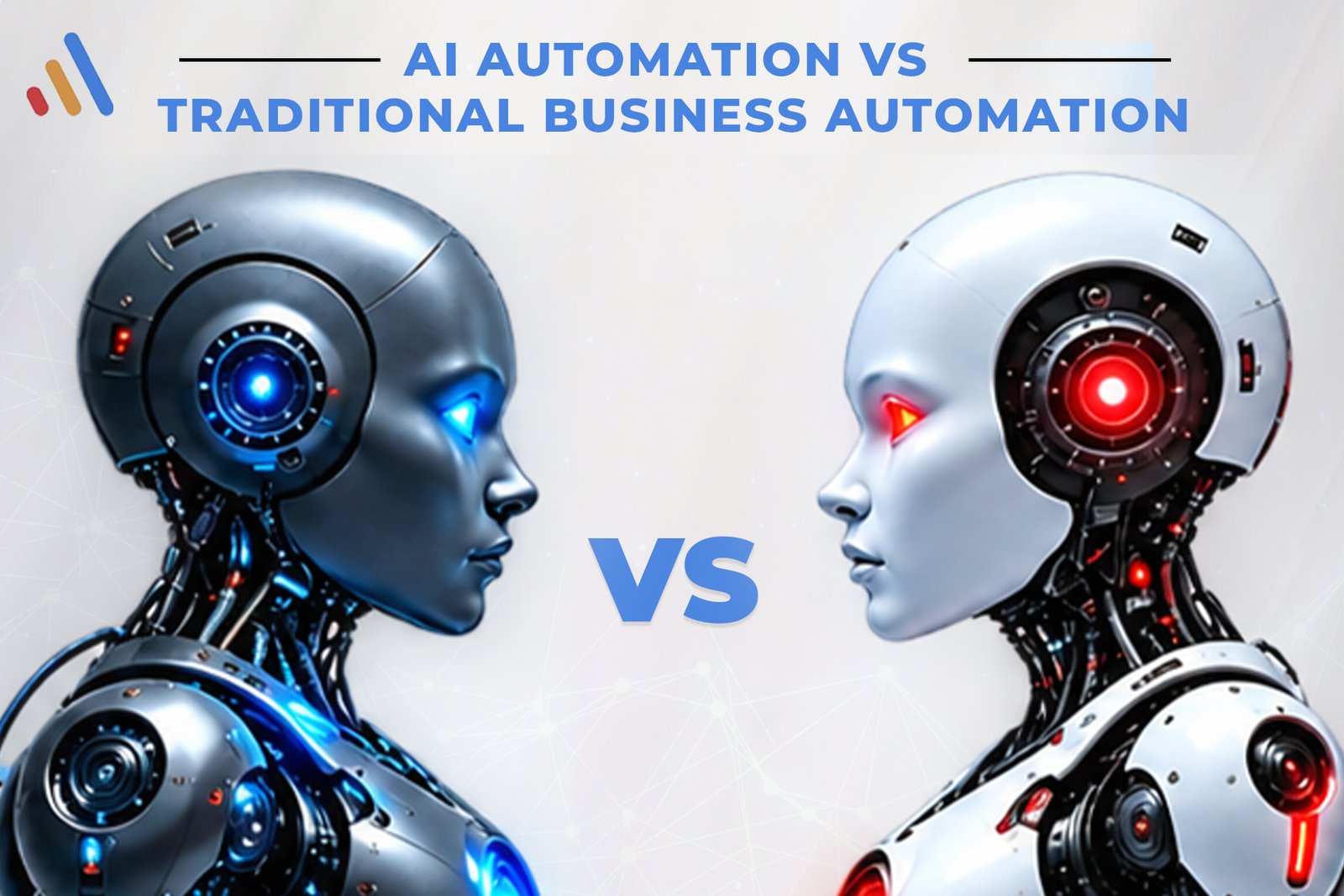
Traditional automation is designed to follow predefined instructions. Artificial intelligence can analyze information, understand patterns, interpret language, and support decisions within a workflow.This difference is driving growing interest in AI business process automation.But does AI automation always make traditional automation obsolete? Not necessarily.
In many organizations, the most practical approach is to combine traditional automation with AI. The right choice depends on the complexity of the process, the type of information involved, the level of decision-making required, and the business outcome the organization wants to achieve.
In this guide, we’ll compare AI process automation with traditional business automation, explain their key differences, explore real-world use cases, and show how businesses can determine which approach fits a particular workflow.
What Is Traditional Business Automation?
Traditional business process automation uses predefined rules, triggers, and workflows to perform repetitive tasks automatically.The logic is generally straightforward:
When X happens → perform Y.
For example, an organization might create an automated workflow where:
New customer completes a form → CRM creates a contact → confirmation email is sent → sales representative receives notification.
The system does not need to understand the customer’s message. It simply follows the instructions that were configured in advance.
Traditional automation works particularly well when a process is:
- Predictable
- Repetitive
- Rule-based
- Structured
- Consistent
- Based on clearly defined inputs and outputs
Common examples include scheduled emails, database updates, invoice workflows, employee notifications, file transfers, and CRM updates.Traditional automation remains valuable because many business processes do not require artificial intelligence.
What Is AI Automation?
AI automation combines automation technologies with artificial intelligence to handle processes that require greater interpretation or decision-making.Instead of simply following fixed instructions, an AI-powered workflow can analyze information and determine what action should happen next.
For example, consider a customer email:
“Hi, I received my order but one of the products is damaged. Can you help me get a replacement?”
A traditional workflow may struggle because the message does not follow a fixed structure.
An AI-powered system can identify:
- Customer intent
- Product issue
- Sentiment or urgency
- Relevant order information
- Required next action
It could then retrieve the order, create a support request, draft a response, and route the issue to the appropriate team.This is where intelligent automation becomes particularly useful.
AI Automation vs Traditional Automation: What’s the Difference?
The biggest difference is how the system handles information.
| Traditional Automation | AI Automation |
| Follows predefined rules | Can interpret information |
| Works best with structured data | Can work with structured and unstructured information |
| Predictable workflows | Can handle variable situations |
| “If X, do Y” logic | Analyze → determine → act |
| Limited decision-making | AI-supported decision-making |
| Requires clearly defined rules | Can process natural language and complex information |
| Best for repetitive predictable tasks | Useful for more dynamic workflows |
Traditional automation is therefore not “old” or ineffective.It simply solves a different type of problem.
How AI Process Automation Works
A typical AI process automation workflow can contain several stages.
1. Information Enters the System
Information can come from:
- Emails
- Website forms
- Customer conversations
- Documents
- CRM systems
- Databases
- Applications
- APIs
- Mobile apps
2. AI Interprets the Information
The AI system analyzes the incoming information.
For example, it might determine whether a message is:
- A sales inquiry
- A technical issue
- A billing question
- A complaint
- A product request
3. The System Determines the Next Step
The AI output can be combined with business rules to determine what should happen next.
4. Automation Executes the Action
The system can then:
- Update a CRM
- Send an email
- Create a ticket
- Schedule an appointment
- Generate a document
- Notify an employee
- Trigger another workflow
5. Human Intervention Can Be Added
Not every situation should be handled automatically.Businesses can design workflows where AI handles routine cases and sends complex or sensitive cases to a human employee.
VCL International’s AI Agent Development Services are designed around this type of workflow, including CRM and ERP connectivity, API integrations, task execution, customer service, and human handoff.
Traditional Automation vs AI Automation: A Simple Example
Imagine an online business receives customer support emails.
Traditional Automation
The workflow might look like:
Email received → check sender → assign ticket → send standard response
This works when customers follow predictable formats.
AI Automation
The workflow could become:
Email received → AI understands request → identifies customer intent → retrieves relevant information → determines response → updates support system → responds → escalates if necessary
The second workflow can deal with more variation because AI can interpret the customer’s language.This is one reason automated customer service is becoming an important application of AI.
Automated Customer Service: AI vs Traditional Systems
Customer service provides a useful example of the difference between the two approaches.Traditional automation can handle predictable requests such as:
- Sending order confirmations
- Providing tracking links
- Sending password-reset emails
- Routing tickets
- Triggering notifications
AI can add another layer.An AI-powered customer service workflow can understand questions written in natural language and determine what the customer is trying to accomplish.
For example:
Customer:
“Can I change the delivery address for my order?”
Instead of matching the message to a predefined keyword, an AI system can understand the request, retrieve the relevant order information, determine whether the order can still be modified, and either complete the appropriate workflow or escalate it.
VCL’s AI Agent solutions specifically include customer service agents capable of handling inquiries, resolving common issues, managing support requests, and escalating complex cases.
Where Traditional Automation Still Makes More Sense
AI is powerful, but businesses should not automatically use AI for every workflow.Traditional automation can be the better fit when:
The Process Is Completely Predictable
If a workflow always follows the same sequence, AI may add unnecessary complexity.
For example:
Invoice approved → update accounting system → send notification
There may be no reason to introduce an AI model.
The Rules Are Clear
If the process can be completely described with straightforward conditions, traditional automation may be sufficient.
The Data Is Structured
Processes involving fixed fields, predefined values, and predictable database records often work well with conventional automation.
Speed and Simplicity Are Priorities
A simple rule-based workflow can be easier to build, test, maintain, and troubleshoot than an AI-powered system.The goal should not be to maximize the amount of AI.The goal should be to solve the business problem efficiently.
When AI Automation Becomes More Valuable
AI becomes more useful when a workflow contains information that is difficult to process using fixed rules.
Examples include:
Unstructured Information
Emails, documents, conversations, reviews, and other natural-language information can be difficult to handle with conventional automation.
Context-Based Decisions
Some workflows require understanding the meaning of information before deciding what happens next.
Large Volumes of Data
AI can help analyze large quantities of information and identify patterns that would take employees significant time to review manually.
Natural Language
If customers or employees communicate using different words and sentence structures, AI can interpret the intent behind those messages.
Changing Inputs
Traditional automation can become difficult to maintain when the possible inputs are highly variable.
AI can provide greater flexibility in these situations.
AI Business Process Automation and Artificial Intelligence Integration
One of the most important parts of AI automation is connecting AI to existing business systems.AI does not need to operate as a separate application.
Through artificial intelligence integration, businesses can connect AI capabilities with:
- CRMs
- ERPs
- Databases
- Websites
- E-commerce platforms
- Internal applications
- APIs
- Cloud platforms
For example:
Customer message → AI → CRM → customer information → AI → response → support ticket
This allows AI to work with business information rather than simply generating isolated responses.
VCL International’s Artificial Intelligence Integration Services focus on embedding AI into existing technology environments, including workflow automation and integration with business systems.
AI Automation vs Traditional Automation: Cost Considerations
Cost is another important factor when choosing between the two approaches.Traditional automation can be relatively straightforward when the workflow has simple rules and limited integrations.AI automation can require additional components such as:
- AI models
- API usage
- Data processing
- AI infrastructure
- Monitoring
- Integration development
- Testing
- Ongoing optimization
However, the technology cost alone should not determine the decision.Businesses should consider the total value of the workflow.
For example, if employees spend hundreds of hours every month reviewing customer messages, an AI system that reduces manual processing may create significant operational value.
On the other hand, if a task takes only a few minutes each week, introducing AI may not provide enough benefit to justify the additional complexity.
AI Automation and Business Productivity
Both approaches can improve productivity, but they do so differently.Traditional automation primarily removes repetitive steps.AI automation can additionally reduce the amount of human interpretation required within a workflow.Consider a document-processing process.
Traditional Approach
Employee receives document → reads document → enters information → updates system.
AI Approach
Document received → AI extracts information → classifies document → validates relevant information → updates system → employee reviews exceptions.
The second workflow can move employees away from repetitive data processing and toward exception handling and higher-value activities.
VCL’s AI software development solutions include intelligent workflow automation, natural language processing, predictive analytics, API integration, and AI-powered customer solutions.
Combining AI and Traditional Automation
The choice does not have to be:
AI OR traditional automation.
In many cases, the strongest workflow combines both.
For example:
Customer email → AI interprets request → business rules check account status → CRM is updated → automated email is sent → complex cases go to employee
Here, AI handles interpretation while traditional automation handles predictable actions.This hybrid model can provide a practical balance between flexibility and control.
A Practical Hybrid Automation Example
Consider an e-commerce company handling product returns.The complete workflow could look like this:
Step 1: Customer Request
The customer sends a message requesting a return.
Step 2: AI Interpretation
AI determines:
- What product is involved
- Why the customer wants a return
- Whether the message contains the required information
Step 3: Business Rules
Traditional automation checks:
- Order status
- Purchase date
- Return eligibility
- Customer account information
Step 4: Automated Action
If the request meets the company’s rules, the system creates the return request and sends instructions.
Step 5: Human Escalation
If the request falls outside the standard policy, it is sent to an employee.This is a strong example of how AI and traditional automation can complement each other.
How to Choose the Right Automation Approach
Before implementing automation, ask several questions.
Question 1: Is the process predictable?
If yes, traditional automation may be enough.
Question 2: Does the process involve natural language?
If yes, AI may provide additional value.
Question 3: Does someone need to interpret information?
If yes, investigate whether AI can assist with that interpretation.
Question 4: Are there clearly defined business rules?
If yes, traditional automation can handle those rules alongside AI where necessary.
Question 5: How frequently does the process occur?
High-volume workflows generally provide more opportunity for measurable automation benefits.
Question 6: What happens if the system makes a mistake?
The more important the decision, the more carefully the workflow should be designed with validation and human oversight.
Building an AI Automation Strategy
Businesses should approach automation as a process-improvement initiative rather than simply a technology purchase.
Step 1: Map Current Processes
Document how work currently moves through the organization.
Identify:
- Manual steps
- Delays
- Repetitive work
- Data entry
- Decision points
- Existing software
Step 2: Find Bottlenecks
Look for activities that consume significant employee time or create delays for customers.
Step 3: Classify Each Process
Determine whether each workflow is:
- Rule-based
- AI-suitable
- Hybrid
- Not suitable for automation
Step 4: Select a Pilot
Start with one clearly defined workflow.
Step 5: Measure Results
Track:
- Processing time
- Manual effort
- Error rates
- Response times
- Operational costs
- Customer experience
Step 6: Expand
Once the initial workflow performs reliably, apply the same approach to additional processes.
For organizations that need custom systems rather than simple workflow tools, VCL International’s Software Development Services include custom development and modernization of business software, including integrating AI capabilities into existing applications.
Common Mistakes Businesses Make
Using AI Where Simple Automation Is Enough
Not every workflow needs artificial intelligence.
Treating AI as a Standalone Tool
The greatest value often comes from connecting AI with existing business systems.
Ignoring Human Oversight
Some workflows need human review, particularly when mistakes can have significant consequences.
Automating a Poor Process
Automation cannot automatically fix a fundamentally inefficient workflow.
Focusing Only on Technology Costs
Businesses should also consider employee time, process delays, error rates, customer experience, and scalability.
The Future of Business Process Automation
The distinction between traditional automation and AI automation will likely become less rigid as businesses combine both technologies within the same workflows.Traditional automation will continue handling predictable actions.
AI will increasingly handle interpretation, classification, natural-language interaction, recommendations, and more complex workflow decisions.The result is a more flexible form of intelligent automation.
For example:
AI understands → business rules validate → automation executes → human reviews exceptions
This model allows organizations to use AI where intelligence is required while keeping conventional automation where deterministic processes are more appropriate.
Frequently Asked Questions
What is the difference between AI automation and traditional automation?
Traditional automation follows predefined rules and workflows. AI automation can additionally interpret information, recognize patterns, process natural language, and support decisions within a workflow.
Is AI automation better than traditional automation?
Neither approach is universally better. Traditional automation can be suitable for predictable, rule-based processes, while AI automation can be useful for workflows involving variable information, natural language, or contextual interpretation.
What is AI business process automation?
AI business process automation uses artificial intelligence within business workflows to interpret information, automate tasks, support decisions, and connect different business systems.
What is intelligent automation?
Intelligent automation combines automation technologies with AI capabilities to handle workflows that may require interpretation, classification, prediction, or context-based actions.
Can AI and traditional automation work together?
Yes. A business can use AI for tasks such as interpreting customer requests while traditional automation handles predictable actions such as updating databases, sending notifications, or applying predefined rules.
What is automated customer service?
Automated customer service uses software to handle customer interactions and support workflows with limited manual intervention. AI can make these systems more flexible by understanding natural-language questions and determining the appropriate response or action.
Does AI automation require custom software?
Not always. Some workflows can be implemented using existing automation platforms and AI services. Custom development can become useful when businesses need specialized logic, complex integrations, proprietary systems, or customized AI functionality.
Final Thoughts
The comparison between AI automation vs traditional business automation is not really about choosing one technology for an entire organization.It is about choosing the right technology for each process.Traditional automation remains highly effective for predictable, rule-based tasks.
AI automation becomes valuable when workflows involve natural language, unstructured information, variable inputs, pattern recognition, or contextual decision-making.
The most practical strategy for many businesses is therefore a combination of both:
Traditional automation for predictable actions + AI for intelligent interpretation + human oversight for important exceptions.
This approach can create more flexible workflows without adding unnecessary complexity to simple processes.
As businesses modernize their operations, AI process automation, artificial intelligence integration, and intelligent automation can become important components of a broader digital transformation strategy.
VCL International helps businesses develop AI-powered software, integrate artificial intelligence into existing systems, and build intelligent workflows around real business requirements.
If your organization is evaluating where AI could improve its existing processes, explore VCL International’s AI services to see how AI integration, software development, and intelligent automation can fit into a broader technology strategy.