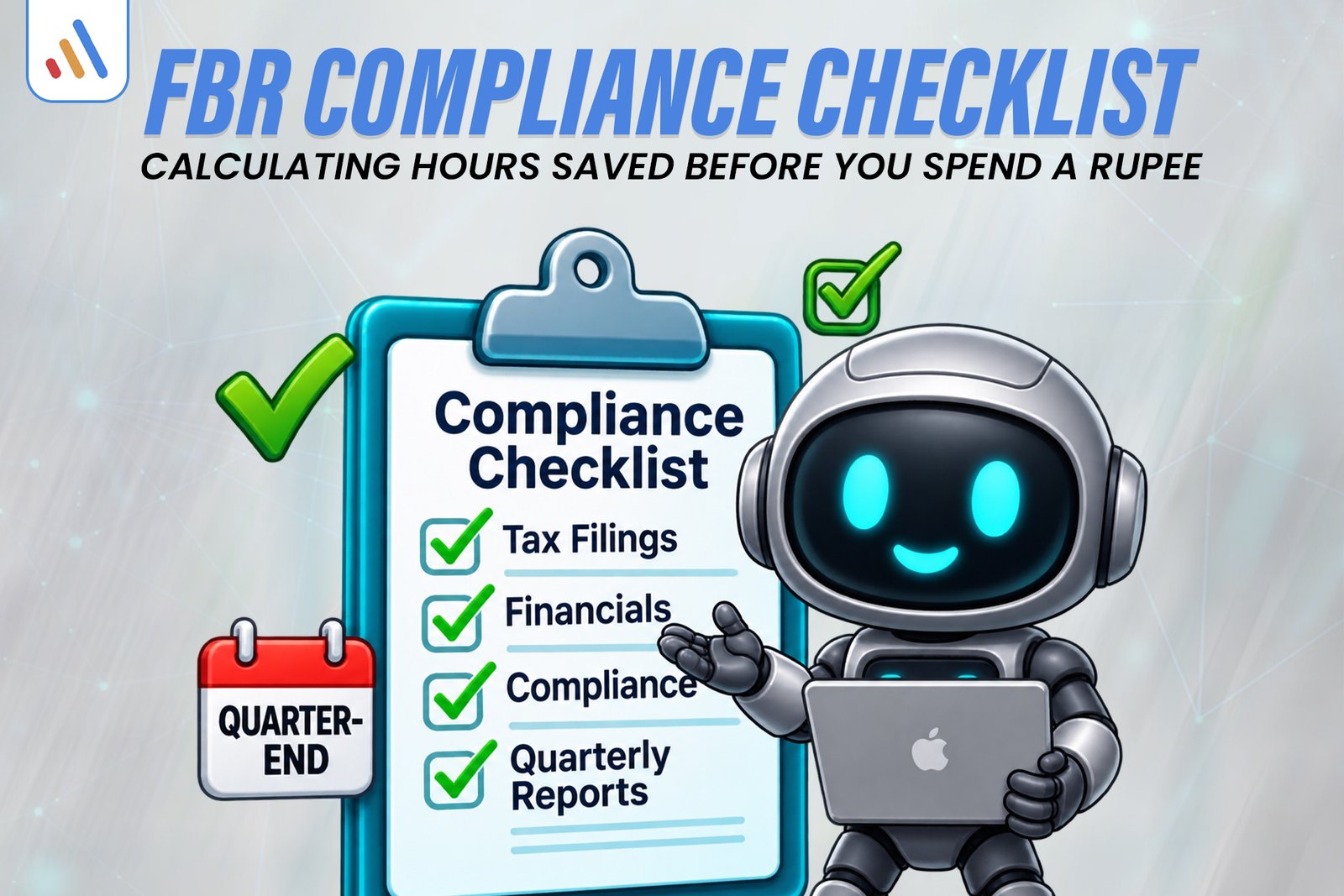
Quarter-end is the right time to check whether your business records, sales tax invoices, reporting systems, and tax filings are aligned with Federal Board of Revenue (FBR) requirements. Missing invoices, incorrect tax calculations, incomplete purchase records, or an unreliable digital invoicing connection can create problems when preparing returns, paying advance tax, or responding to an audit.
This FBR compliance checklist helps Pakistani businesses identify common gaps before closing a reporting period. It covers FBR compliance requirements in Pakistan across registration, digital invoicing, sales and purchase records, reporting, quarter-end deadlines, and penalty risks.
The goal is simple: make sure your business can explain what it sold, what tax it charged, what it purchased, and how those transactions were reported.
1. Confirm Your FBR Registration and Taxpayer Details
Start by confirming that your business registration and taxpayer information are accurate and current. Your compliance responsibilities depend on your business structure, activities, registration status, and applicable tax laws.
Before quarter-end, check:
- Your National Tax Number (NTN) and relevant sales tax registration details.
- Whether your business is required to register for sales tax.
- Whether your registered business name and address match your official records.
- Whether your business activities and applicable tax registrations are correctly reflected.
- Whether your taxpayer information needs updating.
Importers, wholesalers, distributors, manufacturers, and certain retailers are among the categories identified in FBR’s sales tax registration guidance. However, registration obligations depend on the applicable legal definitions and exemptions.
Do not assume that every business has identical FBR obligations. Review your registration status against the latest FBR sales tax registration guidance.
2. Check Your Digital Invoicing and FBR Integration
Digital invoicing is one of the most important items on your FBR compliance checklist. FBR’s published guidance addresses electronic invoicing for sales tax-registered persons and integration of applicable POS, ERP, or invoicing systems through licensed integrators.
Check the following:
- Your business has assessed its applicable digital invoicing obligations.
- Your invoicing software is configured for the required electronic invoice format.
- Your integration uses an FBR-approved or licensed integrator where required.
- Electronic invoices are transmitted to FBR as prescribed.
- Invoice records and system responses can be retrieved when needed.
- Your team knows how to handle technical interruptions and failed transmissions.
An important distinction: a scanned paper invoice is not automatically a compliant structured electronic invoice. FBR describes an electronic invoice as a digitally created invoice in a specified structured format.
Also check how your system handles invoice corrections. Sales Tax General Order No. 01 of 2026, dated March 30, 2026, states that a valid electronic sales tax invoice may be cancelled, deleted, or edited through the Board’s computerized system within 72 hours for a bona fide mistake. Corrections after that period require prior approval from the concerned Commissioner Inland Revenue.
For further explanation, read our guide to FBR digital invoicing requirements.
3. Review Sales Tax Invoices and Tax Calculations
A digital invoicing connection alone does not guarantee accurate tax reporting. Your invoice information must also reflect the actual transaction and the applicable tax treatment.
Review a sample of sales invoices from different business activities and check:
- Invoice numbers and transaction dates.
- Seller and buyer information, where required.
- Product or service descriptions.
- Quantities and taxable values.
- Applicable sales tax rates and tax amounts.
- Discounts, returns, and adjustments.
- Correct product classifications and relevant HS codes.
Pay particular attention to products that share an HS code but have different descriptions or tax treatments. FBR’s digital invoicing FAQs explain that different SKUs should remain distinguishable where their descriptions and sale or purchase classifications differ.
Another important check is the time of supply. FBR guidance identifies the relevant time of supply as the earlier of receipt of payment or delivery of goods.
Do not use one default tax rate for every product or transaction. Have your tax adviser verify rates, exemptions, and special treatments against the current Sales Tax Act and applicable notifications.
4. Reconcile Sales, Purchases, and Supporting Records
Your sales and purchase records should support the figures reported in your sales tax return. Reconciliation helps identify missing invoices, duplicate entries, incorrect tax amounts, and transactions recorded in the wrong reporting period.
Use this sales tax compliance checklist:
Sales records
- Match sales invoices against accounting records.
- Review cash, bank, card, and online sales.
- Identify missing or duplicate invoices.
- Check sales returns and credit notes.
- Reconcile output tax with recorded taxable sales.
Purchase records
- Match supplier invoices against purchase entries.
- Verify supplier information and relevant tax details.
- Review purchase returns and debit or credit adjustments.
- Check input tax claims against supporting documentation.
- Identify duplicate or unsupported purchase entries.
Payment records
- Match tax payments with the relevant reporting period.
- Retain payment confirmations and supporting documents.
- Investigate differences between accounting and tax records.
FBR’s recordkeeping guidance identifies important sales details, including description, quantity, value, customer name and address, and tax charged. It also requires registered persons to maintain relevant records and documents for six years after the end of the applicable tax period.
5. Verify Your FBR Reporting and Return Preparation
Before filing, make sure your accounting records and electronic invoices agree with the figures being reported. A reporting connection does not remove the need for reconciliation and review.
Your finance team should:
- Compare recorded sales with the invoices issued during the tax period.
- Reconcile purchase records and eligible input tax.
- Review debit notes, credit notes, returns, and adjustments.
- Investigate differences between accounting software and FBR reporting.
- Confirm the relevant sales tax return period and applicable filing deadlines.
- Review the completed return before submission.
- Save the submitted return, attachments, and payment evidence.
Which FBR tax filing requirements apply to you?
FBR tax filing requirements differ by tax type, and sales tax and income tax obligations are not interchangeable. In general:
- Sales tax: registered persons file a monthly sales tax return, generally due by the 15th of the following month.
- Income tax: companies, AOPs, and individuals file an annual income tax return, and many must also pay advance tax in quarterly instalments (covered in the next section).
- Withholding: businesses that deduct or collect tax at source have separate periodic statement and payment obligations.
Confirm which returns apply to your business and follow the relevant statutory deadlines. You can consult the official FBR Sales Tax Act resources and sales tax records guidance when reviewing your reporting process.
6. What Is Actually Due at Quarter-End?
Pakistan’s sales tax returns are monthly, so quarter-end is not a sales tax filing date in itself. It is, however, the natural point to reconcile three months of returns and to check quarterly obligations.
Quarterly advance income tax (Section 147). Taxpayers whose income was charged to tax in the latest year, subject to specified exclusions, generally pay advance tax in quarterly instalments. The instalments fall in September, December, March, and June. Published guidance shows the due date varies by taxpayer category and quarter (for example, the 15th or the 25th of the month for the first three instalments, and June 15 for the last), so confirm the exact date that applies to you on FBR’s website or with your tax adviser.
Quarter-end reconciliation. Even where nothing is due to FBR on the last day of the quarter, use it to check that:
- The three monthly sales tax returns match your accounting records and issued electronic invoices.
- Input tax claimed across the quarter is supported by valid supplier invoices.
- Output tax and input tax balances agree with your ledgers.
- Advance tax paid, including tax withheld at source, is recorded so it can be adjusted in your annual return.
- Failed or pending digital invoice transmissions from the quarter have been resolved.
Deadlines and rules can change through the Finance Act, SROs, and notifications, so verify each date against current FBR sources before relying on it.
7. Test Your POS, ERP, and Accounting Workflows
If your business uses multiple systems, quarter-end is a good opportunity to check whether they exchange accurate information.
For example, an ecommerce order might appear in your online store but fail to update your accounting software. Similarly, a POS transaction could be recorded internally without being transmitted through the required FBR integration.
Review these workflows:
- POS transactions flow into accounting records.
- Ecommerce orders are included in sales reporting.
- Inventory changes match recorded sales and returns.
- Tax calculations use the correct configured rules.
- Digital invoices can be retrieved and matched with transactions.
- Access to financial and tax records is restricted to authorized staff.
These are recommended operational controls, not separate statutory requirements in every case. Their purpose is to reduce manual errors and make reporting more reliable. Businesses with multiple outlets or online sales channels may benefit from connected software development and ecommerce solutions.
8. Identify Compliance Gaps That Can Trigger Penalties
A final review should identify problems that need attention before the relevant filing deadline, because gaps in records and filings are what most often lead to penalties and notices.
Look for:
- Missing or incomplete sales invoices.
- Incorrect product tax classifications.
- Unreconciled purchase records.
- Failed digital invoice transmissions.
- Incorrect reporting periods.
- Unsupported input tax claims.
- Missing payment confirmations.
- Incomplete supporting documents.
What can these gaps cost?
The consequences depend on the type of default and the tax involved. Common examples include:
- Late filing or late payment of sales tax: the Sales Tax Act provides for penalties under Section 33 and default surcharge under Section 34 on unpaid tax.
- Late payment of advance income tax: default surcharge under Section 205 of the Income Tax Ordinance can apply from the due date until payment, and unpaid advance tax is treated as tax due under an assessment, which gives FBR recovery powers.
- Unsupported input tax or incorrect invoices: input tax may be disallowed, and incorrect or missing invoicing can attract penalties.
- Wider consequences: a weak compliance record can affect your status on the Active Taxpayer List, which can mean higher withholding rates on transactions.
Penalty amounts and conditions are amended regularly, including in recent budgets, so check the current Sales Tax Act, Income Tax Ordinance, and FBR notifications for exact figures before quoting them.
Assign each issue to a responsible person, record the correction required, and keep evidence of the resolution. If your team cannot resolve an issue internally, consult a qualified tax professional before changing submitted records or making adjustments.
Frequently Asked Questions
1. What is an FBR compliance checklist?
An FBR compliance checklist is a practical list of registration, invoicing, recordkeeping, reporting, and tax filing checks that help businesses review their obligations under applicable Pakistani tax laws.
2. Are FBR digital invoices mandatory for every business?
FBR has published electronic invoicing requirements for sales tax-registered persons. Businesses should verify their applicable obligations, exemptions, integration requirements, and any subsequent notifications rather than assuming that every business has identical responsibilities.
3. How long should a business retain sales tax records in Pakistan?
FBR’s published guidance requires registered persons to maintain relevant records and documents for six years after the end of the tax period to which they relate.
4. What happens if an electronic invoice contains an error?
FBR’s Sales Tax General Order No. 01 of 2026 allows certain bona fide corrections through the Board’s computerized system within 72 hours of invoice generation. Corrections after 72 hours require prior approval from the concerned Commissioner Inland Revenue.
5. Does an ERP system automatically make a business FBR compliant?
No. An ERP system can organize transactions, support reporting, and connect business workflows, but it does not automatically establish legal compliance. Correct configuration, applicable FBR integration, accurate records, and timely tax filings remain essential.
6. Is anything due to FBR at quarter-end?
Sales tax returns are monthly, but many income taxpayers must pay advance tax in quarterly instalments under Section 147. The exact due dates depend on your taxpayer category, so confirm them against current FBR guidance.
Prepare Your Business for a More Reliable Quarter-End
Simplify FBR compliance by connecting your registration, invoicing, accounting, and reporting processes. VCL International helps businesses improve POS, ERP, ecommerce, and accounting workflows. Book a consultation to identify gaps and streamline your systems.
Book a consultation