Businesses are no longer competing only on products, pricing, or customer service. They are also competing on how quickly they can process information, respond to customers, manage operations, and adapt to changing demands.
This is where AI business automation is becoming an important part of digital transformation.But what is AI business automation really capable of beyond generating content or answering questions?
At its core, AI business automation combines artificial intelligence with business processes to help organizations handle work that previously depended heavily on manual effort. The technology can interpret information, coordinate tasks, communicate with customers, and work across multiple business systems.The bigger opportunity, however, is not simply automating individual tasks.It is redesigning how work moves through an organization.
In this guide, we’ll look at AI business automation from a business-process perspective, including where companies can apply it, how to identify valuable automation opportunities, how to measure results, and how organizations can build an automation strategy that can grow over time.
What Is AI Business Automation?
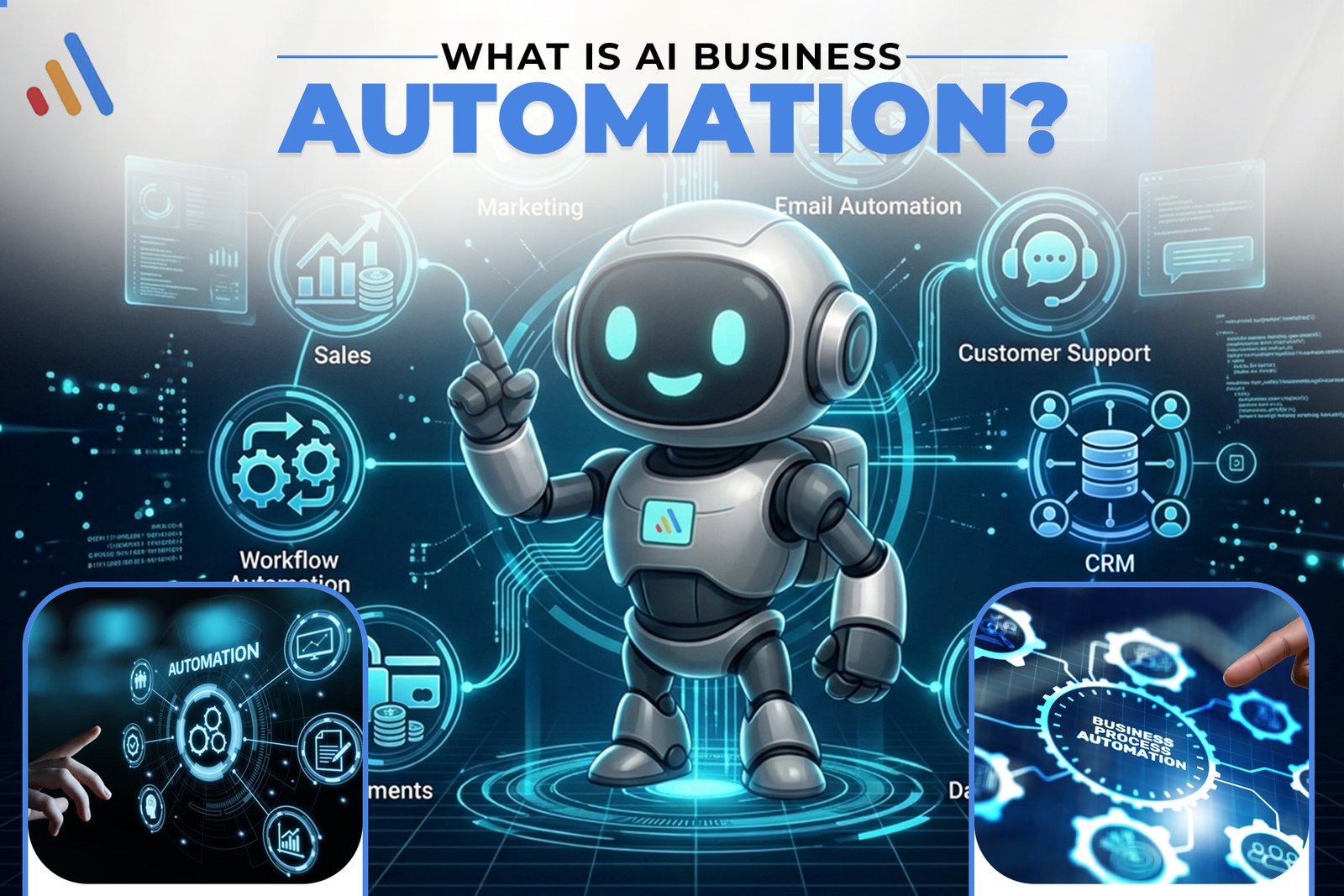
AI business automation is the use of artificial intelligence to improve, coordinate, and automate business processes.
Instead of employees manually moving information from one stage of a process to another, AI-powered systems can help interpret information and trigger the next appropriate action.
Consider a traditional lead management process.A potential customer submits a form.
An employee then:
- Opens the submission
- Reads the information
- Determines whether the person is a qualified lead
- Enters the details into a CRM
- Sends a follow-up email
- Assigns the lead to a salesperson
- Creates a reminder
- Updates the lead status
With AI business automation, much of this workflow can happen automatically.
The system can understand the submitted information, classify the lead, update the CRM, personalize the communication, notify the appropriate salesperson, and schedule the next action.The important difference is that AI becomes part of the business process, rather than being used as a standalone tool.
Why AI Business Automation Is Different From Simply Using AI
Many companies already use AI tools.Employees may use AI to write emails, summarize meetings, generate ideas, analyze documents, or create marketing content.That is useful, but it is not necessarily business automation.AI business automation connects AI capabilities to an actual workflow.
For example:
Using AI
Employee → asks AI to summarize a customer email → receives summary
AI automation
Customer email → AI reads message → identifies intent → retrieves customer information → updates CRM → generates response → sends response → creates follow-up task
This distinction is important because the value of automation often comes from what happens before and after the AI processes information.
Where Does AI Business Automation Create the Most Value?
Not every business activity needs AI.The strongest opportunities often exist where employees repeatedly perform similar actions across multiple systems.
Common characteristics include:
- High transaction volume
- Repetitive employee activity
- Large amounts of information
- Frequent customer communication
- Multiple software systems
- Repeated decision points
- Manual data transfer
- Delays between process stages
For example, imagine an organization where employees receive hundreds of emails every day and manually determine which department should handle each one.
AI could classify incoming messages and automatically route them.The business does not necessarily need to automate the entire department.It may only need to remove the repetitive bottleneck.
AI Business Automation by Business Function
AI automation can be applied differently depending on the department.Rather than treating AI as one universal solution, businesses should look at individual workflows.
Sales Operations
Sales teams frequently spend time on activities surrounding the actual sales conversation.AI automation can support workflows involving:
- Lead intake
- Lead qualification
- CRM updates
- Follow-up scheduling
- Meeting summaries
- Prospect research
- Sales notifications
- Customer communication
For example, when a new lead arrives, an automated system could analyze the available information and determine which sales workflow should be triggered.This allows sales representatives to spend more time engaging with prospects rather than maintaining records manually.
Customer Experience
Customer service is another area where automation can improve the flow of information.Instead of forcing customers to navigate multiple systems, AI can act as an interface between the customer and the business.A customer could ask a question through a website.
The system can:
- Understand the request
- Find relevant information
- Check available customer data
- Provide an answer
- Create a ticket if necessary
- Escalate the conversation when human assistance is required
For businesses looking to develop intelligent customer-facing systems, VCL International offers AI Agent Development Services for building AI-powered agents that can interact with business systems.
Operations
Operations teams often work with processes that involve several applications.
For example:
Order received → information verified → inventory checked → internal system updated → customer notified
AI automation can help coordinate information between these stages.
The objective is not necessarily to replace the operational team.
Instead, the goal is to reduce unnecessary manual coordination.
Marketing
Marketing departments handle a large amount of repetitive information and communication.
AI automation can support workflows such as:
- Lead nurturing
- Customer segmentation
- Campaign personalization
- Content workflows
- Reporting
- Marketing data analysis
- Customer feedback analysis
AI can also help teams turn large amounts of customer information into useful insights.VCL International’s AI Software Development Services can be used to create customized AI functionality around specific business requirements.
Finance
Financial departments frequently process structured documents and repetitive information.
Potential automation areas include:
- Invoice information extraction
- Expense processing
- Payment reminders
- Financial document classification
- Report preparation
- Data reconciliation
- Internal financial queries
Human review can remain part of the workflow for sensitive or high-impact financial activities.
Human Resources
HR departments can also use automation to reduce administrative workload.
For example:
Candidate application → information extraction → candidate categorization → interview scheduling → notification
Other opportunities include employee onboarding, internal knowledge systems, document workflows, and routine employee requests.
How AI Business Automation Changes a Workflow
One of the easiest ways to understand AI automation is to compare a manual workflow with an intelligent workflow.
Manual Workflow
Customer submits inquiry.
↓
Employee opens email.
↓
Employee reads the request.
↓
Employee searches for customer information.
↓
Employee enters information into CRM.
↓
Employee writes response.
↓
Employee creates follow-up reminder.
↓
Employee updates CRM again.
This process can involve significant repetitive work.
AI-Assisted Workflow
Customer submits inquiry.
↓
AI analyzes the request.
↓
Relevant customer information is retrieved.
↓
CRM is updated automatically.
↓
AI generates an appropriate response.
↓
Customer receives response.
↓
Follow-up task is created.
↓
Human employee receives the conversation when intervention is required.
The result is not simply “AI doing the employee’s job.”
The workflow itself has been redesigned.
How AI Business Automation Works With Existing Software
Businesses rarely operate using one application.
A typical organization may use:
- CRM software
- Accounting software
- E-commerce platforms
- Email systems
- Databases
- ERP software
- Project management tools
- Customer support platforms
- Internal applications
AI automation becomes significantly more useful when these systems can communicate with each other.
For example:
Website → AI → CRM → Email → Calendar → Sales Dashboard
Instead of employees manually transferring information between applications, automation can coordinate the movement of information.
VCL International provides AI Integration Services for connecting AI capabilities with existing software, applications, databases, and business environments.
The Role of APIs in AI Business Automation
APIs are an important part of modern business automation.An API allows different software systems to exchange information.
For example, an AI system may need to retrieve customer information from a CRM before responding to a request.
The workflow could look like:
Customer request → AI → API → CRM → customer data → AI → response
This allows AI to work with real business information rather than operating in isolation.
For businesses with complex requirements, custom integration can also connect AI systems to internal applications and databases.VCL International’s Software Development Services can support custom systems and integrations where standard automation platforms do not provide enough flexibility.
AI Business Automation and Return on Investment
One of the most important questions businesses should ask is:
What business value will this automation create?
AI should not be implemented simply because it is a popular technology.A business should identify measurable outcomes.
For example, suppose a company processes 5,000 customer inquiries every month.
If employees spend an average of five minutes manually categorizing each inquiry, that represents:
5,000 × 5 minutes = 25,000 minutes
That is more than 416 hours per month spent on one repetitive activity.
If AI can reliably handle a significant portion of the classification process, employees can spend that time on activities requiring human involvement.
The same principle applies to:
- Data entry
- Document processing
- Lead qualification
- Reporting
- Scheduling
- Customer communication
- Internal requests
How to Measure AI Automation Results
Successful automation should be measurable.Businesses can track several metrics before and after implementation.
Time Saved
How much employee time is removed from repetitive work?
Processing Speed
How long does the workflow take before and after automation?
Error Rate
Are manual errors decreasing?
Response Time
Are customers receiving answers faster?
Throughput
Can the business process more requests without increasing manual workload at the same rate?
Employee Productivity
Are employees spending more time on higher-value activities?
Cost Per Transaction
Has the amount of effort required for each transaction changed?
Customer Experience
Are response times, satisfaction levels, or resolution rates improving?
These measurements make it easier to determine whether an automation project is delivering practical business value.
A Practical AI Automation Roadmap
Businesses do not need to transform every department simultaneously.A phased approach can make automation easier to manage.
Phase 1: Discover
Start by documenting existing workflows.
Ask:
- Which processes are repetitive?
- Which tasks consume the most employee time?
- Where are delays occurring?
- Where do employees repeatedly copy information?
- Which processes involve multiple software systems?
Phase 2: Prioritize
Create a list of potential automation opportunities.
Consider:
Frequency + Time Required + Business Impact + Automation Feasibility
A workflow that happens thousands of times every month may deserve more attention than a process that happens only a few times each year.
Phase 3: Design
Define the new workflow before selecting technology.
Document:
- Trigger
- Inputs
- AI tasks
- Business rules
- System integrations
- Human approvals
- Outputs
- Exception handling
Phase 4: Pilot
Start with one workflow.A pilot makes it easier to test assumptions, identify errors, measure performance, and collect employee feedback.
Phase 5: Optimize
Once the workflow is operating, review its performance.
Identify:
- Incorrect AI outputs
- Unnecessary steps
- Integration problems
- Exceptions
- Human approval points
- Opportunities for improvement
Phase 6: Scale
After the process is stable, similar workflows can be considered.
This creates an automation roadmap rather than one large technology project.
AI Automation Should Include Human Control
Automation does not always mean complete autonomy.Some business processes require human approval.
For example, an AI system may prepare a recommendation, but an employee may make the final decision.
A workflow can therefore be designed as:
AI analyzes → AI recommends → Human reviews → System executes
This approach can be particularly useful when workflows involve:
- Financial decisions
- Sensitive customer information
- Employee decisions
- Compliance
- Contracts
- High-value transactions
The level of human involvement should depend on the business process and its associated risks.
What Makes an AI Automation Project Scalable?
A successful automation system should not only work today.It should be designed with future growth in mind.
Important considerations include:
Modular Architecture
Different parts of the workflow should be replaceable or expandable.
Integration Flexibility
The system should be able to communicate with the applications the business already uses.
Data Quality
Reliable automation depends on reliable information.
Monitoring
Businesses should be able to identify failures, unexpected behavior, and performance issues.
Security
Access to business information should be controlled appropriately.
Maintainability
AI models, APIs, applications, and workflows can change over time, so systems need ongoing maintenance.
When Should a Business Build Custom AI Automation?
Not every business needs custom development.Existing automation platforms can be suitable for simple workflows.
Custom development becomes more relevant when a business requires:
- Unique business logic
- Complex integrations
- Custom AI functionality
- Internal applications
- Large-scale workflows
- Specialized data processing
- Advanced AI agents
- Greater control over the user experience
For example, a company with a highly specialized sales process may need an automation system designed specifically around its CRM, internal database, customer portal, and approval process.
AI Automation Is a Business Transformation Opportunity
The biggest change created by AI automation is not necessarily the automation of one individual task.It is the possibility of redesigning how information moves through an organization.
Instead of:
Person → Application → Person → Application → Person
businesses can increasingly create workflows where:
Customer → AI → Systems → AI → Employee
The employee can then focus on the parts of the process where human judgment, creativity, communication, and expertise provide value.This is why AI automation for businesses is becoming part of broader digital transformation strategies.
Frequently Asked Questions
What is AI business automation?
AI business automation combines artificial intelligence with automated workflows to help organizations process information, coordinate tasks, communicate with customers, and execute business processes with less manual effort.
How is AI business automation different from normal automation?
Traditional automation generally follows predefined rules. AI-powered automation can additionally interpret information, understand language, classify data, and support decisions within defined business processes.
How can AI automation help a small business?
Small businesses can use AI automation for lead management, customer communication, scheduling, document processing, reporting, marketing workflows, and repetitive administrative activities.
Can AI automation work with existing software?
Yes. AI automation can connect with existing business systems through APIs and integrations. This can allow AI workflows to retrieve information, update records, and trigger actions across different applications.
How do I identify a good AI automation opportunity?
Look for processes that happen frequently, require significant manual effort, involve repetitive decisions, move information between systems, or create delays for employees or customers.
Does every AI automation workflow require a custom AI model?
No. Many workflows can use existing AI models combined with business rules, APIs, databases, and workflow automation. Custom AI development may be useful when the business has specialized requirements.
How should businesses measure AI automation?
Businesses can measure time savings, processing speed, error rates, response times, transaction costs, employee productivity, throughput, and customer experience metrics.
Conclusion
What is AI business automation?
It is more than using an AI chatbot or asking an AI tool to perform an individual task.AI business automation connects artificial intelligence with real business workflows so information can be understood, processes can be coordinated, and actions can happen with less manual intervention.
For businesses, the opportunity is to identify where employees spend time on repetitive work and redesign those processes around intelligent systems.The most practical starting point is not asking where AI can be added.
It is asking:
Which business process is slowing our organization down, and how could technology improve it?
Once that question is answered, businesses can determine whether the right solution involves AI, traditional automation, integrations, custom software, AI agents, or a combination of technologies.
VCL International helps businesses develop AI-powered software, integrations, and intelligent automation solutions around their specific operational requirements.
Contact VCL International to discuss an AI automation project for your business.