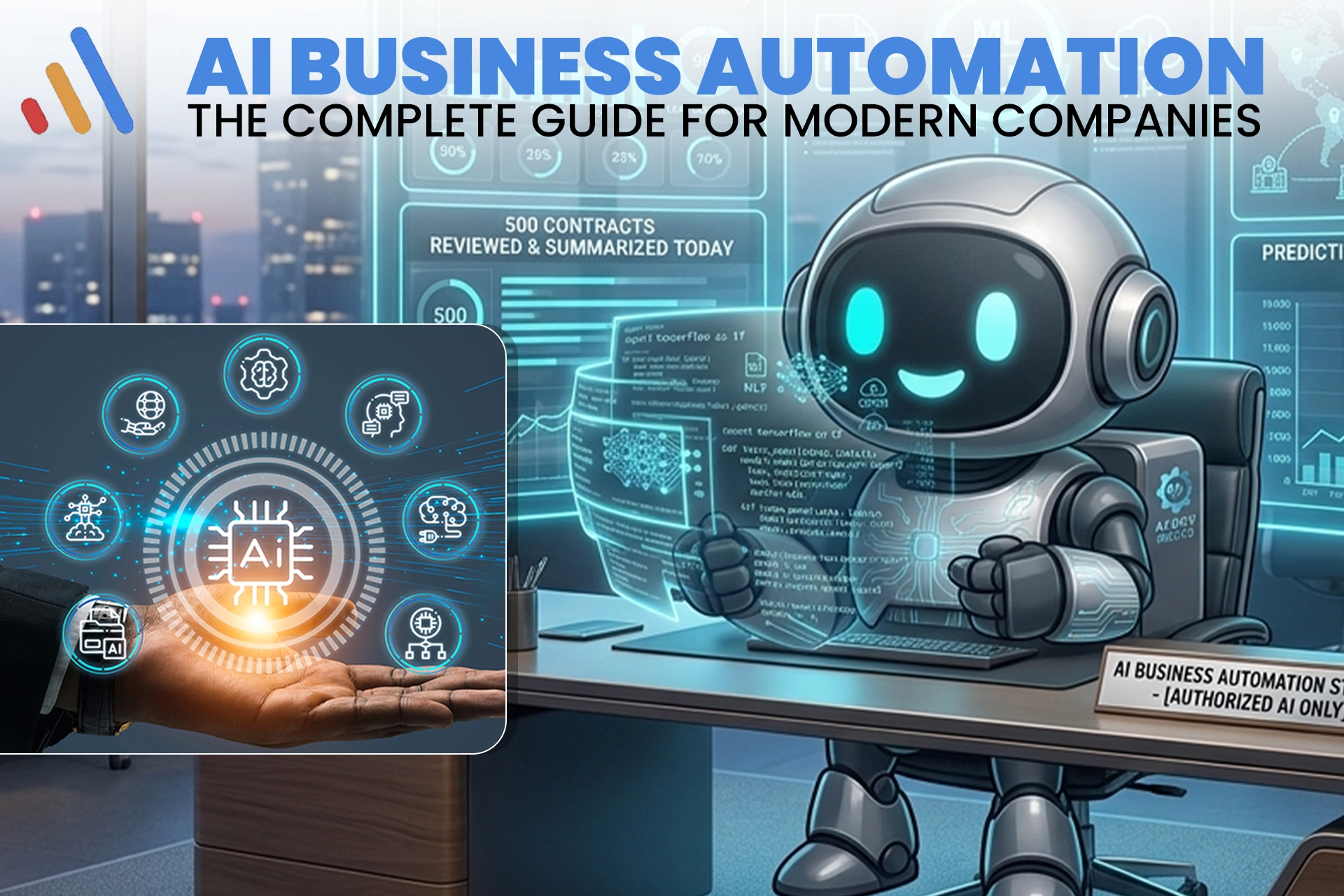
Artificial intelligence is changing how modern companies operate. Tasks that once required hours of manual work can now be handled automatically, intelligently, and at scale.
From customer support and lead management to data processing, reporting, sales follow-ups, and internal operations, AI business automation is helping organizations reduce repetitive work while creating faster and more consistent workflows.But what exactly is AI automation, how does it work, and how can a company implement it without creating unnecessary complexity?
This complete guide explains everything businesses need to know about AI automation, including what IT automation is, how AI-powered workflows work, automation as a service, common business use cases, implementation strategies, benefits, challenges, and how to choose the right AI automation partner.
If your organization is exploring practical ways to introduce AI into everyday operations, you can also explore VCL International’s AI Software Development Services for custom AI-powered business solutions.
What Is AI Business Automation?
AI business automation combines artificial intelligence with automated workflows to perform business tasks with limited human intervention.
Traditional automation usually follows predefined rules:
If X happens → perform Y.
AI automation can go further by understanding information, identifying patterns, making context-based decisions, and triggering the appropriate action.
For example:
- A customer submits an inquiry.
- AI understands the customer’s request.
- The system identifies the customer’s intent.
- Relevant information is retrieved.
- A personalized response is generated.
- The lead is added to the CRM.
- A sales representative is notified if the lead meets specific criteria.
- Follow-up communication can happen automatically.
This turns automation from a simple rule-based process into an intelligent workflow.Companies can implement these capabilities through AI integration services that connect AI technologies with their existing software, applications, databases, and business systems.
What Is IT Automation?
IT automation is the use of software and technology to automatically perform repetitive IT-related tasks that would otherwise require manual intervention.
These tasks can include:
- Software deployment
- System monitoring
- Data backups
- User provisioning
- Security checks
- Infrastructure management
- Testing
- Incident response
- Application updates
- Data synchronization
AI can make IT automation more intelligent by helping systems analyze information, identify anomalies, prioritize events, and recommend or execute actions.For example, instead of simply detecting that a server is experiencing unusual activity, an AI-powered system could analyze the pattern, identify the likely cause, create an incident ticket, notify the appropriate team, and initiate a predefined response.
Businesses looking to combine automation with custom software can explore VCL International’s Software Development Services to build solutions around their existing technology infrastructure.
How Does AI Business Automation Work?
AI automation generally combines several technologies rather than relying on AI alone.
A typical workflow may contain:
1. Data Input
The automation receives information from a source such as:
- Website forms
- Emails
- CRM systems
- ERP platforms
- Documents
- Customer conversations
- Databases
- APIs
- Mobile applications
2. AI Processing
An AI model analyzes the information and determines what it means.
For example, an AI system could classify a customer message as:
- Sales inquiry
- Technical support request
- Billing question
- Complaint
- General information request
3. Decision Making
Based on predefined business rules and AI analysis, the system determines what should happen next.
4. Automated Action
The system performs the appropriate action.
This might mean:
- Sending an email
- Updating a CRM
- Creating a support ticket
- Generating a document
- Scheduling an appointment
- Updating a database
- Notifying an employee
- Triggering another workflow
5. Human Oversight
Not every decision should be completely autonomous. Businesses can define situations where human approval is required.This approach combines automation with human judgment rather than attempting to remove people from every process.
For more advanced workflows, VCL’s AI Agent Development Services can connect AI agents with CRMs, ERPs, databases, APIs, and other business applications.
AI Automation vs. Traditional Automation
Traditional automation and AI automation are related, but they are not identical.
| Traditional Automation | AI Automation |
| Rule-based | Context-aware |
| Predetermined workflows | Can interpret information |
| Structured data | Structured and unstructured data |
| Limited decision-making | AI-assisted decisions |
| “If X, do Y” | Understand → decide → act |
| Predictable inputs | Can process natural language and complex information |
Traditional automation remains useful for predictable processes.
AI automation becomes particularly valuable when workflows involve documents, natural language, customer conversations, large amounts of data, or decisions that require contextual understanding.Businesses can combine both approaches through custom AI software development to create automation that fits their specific workflows.
What Is Automation as a Service?
Automation as a Service (AaaS) is a model where businesses use an external provider to design, implement, manage, and maintain automated workflows instead of building and managing everything internally.
This can be useful for companies that:
- Do not have a large automation team
- Want to implement automation faster
- Need specialist AI expertise
- Have complex integration requirements
- Want ongoing optimization
- Need to connect multiple business systems
Instead of purchasing a single automation tool and figuring everything out internally, a business can work with a technology partner to identify opportunities, design workflows, integrate systems, deploy automation, and continuously improve the solution.
For companies considering this approach, VCL International’s AI Integration Services provide a foundation for connecting AI capabilities with existing business technology.
What Can AI Automate in a Business?
Almost every department can potentially benefit from AI-powered automation.The key is identifying processes where automation can solve a genuine business problem.
Customer Service Automation
AI can help businesses automatically:
- Answer frequently asked questions
- Categorize support requests
- Route tickets
- Summarize conversations
- Generate responses
- Escalate complex issues
- Provide 24/7 assistance
AI agents can also connect customer conversations with internal systems so that employees have relevant information when human intervention is necessary.
Explore VCL’s AI Agent Development Services to learn how intelligent agents can support customer service and business workflows.
Sales Automation
Sales teams can use AI to:
- Capture leads
- Qualify prospects
- Score leads
- Generate personalized messages
- Schedule appointments
- Update CRM records
- Automate follow-ups
- Summarize sales conversations
For example, VCL has documented an AI and CRM automation implementation for a UAE real estate company that combined CRM integration, AI-powered responses, lead scoring, lead nurturing, and appointment scheduling.
Businesses can explore AI integration solutions from VCL International for similar system-connected automation.
Marketing Automation
AI can automate parts of marketing operations such as:
- Customer segmentation
- Content generation
- Campaign personalization
- Email workflows
- Customer analysis
- Lead nurturing
- Reporting
- Recommendation systems
AI does not replace marketing strategy. Instead, it can reduce repetitive operational work so marketing teams can spend more time on strategy, creative direction, and optimization.
For businesses developing AI-powered digital experiences, VCL’s AI Software Development Services can support custom AI functionality.
Finance and Administrative Automation
AI automation can assist with:
- Invoice processing
- Document extraction
- Expense categorization
- Data entry
- Report generation
- Payment reminders
- Financial document analysis
Automating administrative work can reduce the amount of repetitive data processing employees need to perform manually.For more complex requirements, custom software development can be used to build systems around existing business processes.
HR Automation
Human resources teams can automate tasks such as:
- Candidate screening
- Interview scheduling
- Employee onboarding
- Document processing
- Internal HR questions
- Leave requests
- Employee communications
AI-powered assistants can also provide employees with access to internal company knowledge while maintaining appropriate human oversight.
Benefits of AI Business Automation
A properly designed AI automation strategy can affect multiple areas of an organization.
1. Increased Productivity
Employees spend less time performing repetitive tasks and more time on work requiring creativity, judgment, and expertise.
2. Faster Response Times
Automated systems can operate continuously without waiting for an employee to manually process every request.
3. Reduced Manual Work
Tasks involving repetitive data entry, document processing, communication, and system updates can often be automated.
4. Better Consistency
Automated workflows can execute processes according to standardized rules and instructions.
5. Improved Scalability
Automation can help organizations handle increasing workloads without requiring every process to grow at the same rate.
6. Better Business Insights
AI systems can analyze large amounts of information and surface patterns that may be difficult to identify manually.
7. Improved Customer Experience
Faster responses, personalized communication, and 24/7 availability can improve customer interactions.
These benefits are also highlighted across VCL International’s AI Software Development solutions, which focus on automation, productivity, customer engagement, and data-driven decision-making.
How a Business Process Automation Company Can Help
A business process automation company typically helps organizations identify inefficient workflows and replace repetitive manual processes with technology-driven systems.The process generally begins with understanding how the business currently operates.
For example:
Manual process
Customer inquiry → Employee reads email → Employee enters CRM → Employee writes response → Employee schedules follow-up → Employee updates records
Automated process
Customer inquiry → AI understands request → CRM updated → Personalized response → Lead scored → Follow-up scheduled → Sales team notified
The goal is not simply to automate as many tasks as possible.The goal is to automate the right tasks.
A reliable automation partner should consider:
- Existing technology
- Business objectives
- Data quality
- Security
- Integration requirements
- Workflow complexity
- Human approval requirements
- Scalability
- Maintenance
- ROI
VCL International combines AI, software engineering, cloud technology, and enterprise integration to develop customized solutions rather than relying on one-size-fits-all automation.
How to Identify the Right Processes for AI Automation
Not every business process should be automated.A good candidate usually has several of these characteristics:
Repetitive
The task happens frequently and follows a recognizable pattern.
Time-Consuming
Employees spend significant amounts of time completing it.
Rule-Based
There are clear criteria for determining what should happen next.
High-Volume
The business handles a large number of similar requests or transactions.
Data-Heavy
The process requires employees to read, classify, organize, or transfer large amounts of information.
Integration-Dependent
The workflow requires information to move between multiple applications.A simple way to prioritize automation opportunities is to ask:
How often does this happen?
How much employee time does it consume?
How expensive are errors?
How predictable is the process?
Can the workflow be connected to existing systems?
Organizations can then prioritize automation projects based on potential business impact rather than implementing AI simply because it is available.
For complex automation projects, VCL’s AI Integration Services can help connect AI capabilities with existing technology environments.
How to Implement AI Automation Successfully
A successful AI automation project should start with the business problem rather than the technology.
Step 1: Define the Business Problem
Start with a specific problem.
For example:
“Our sales team spends three hours every day manually processing inbound leads.”
This is more useful than saying:
“We want to use AI.”
Step 2: Map the Existing Workflow
Document what currently happens from beginning to end.
Identify:
- Inputs
- Manual actions
- Decisions
- Systems involved
- Outputs
- Bottlenecks
- Common errors
Step 3: Select the Automation Opportunity
Choose a process where automation can produce measurable value.
Step 4: Choose the Technology
Depending on the workflow, the solution may involve:
- AI models
- AI agents
- APIs
- CRM integrations
- RPA
- Databases
- Cloud platforms
- Custom software
- Workflow automation platforms
VCL’s AI Agent Development Services are designed for workflows where AI needs to understand information and execute tasks across connected systems.
Step 5: Build a Pilot
Start with a focused use case rather than attempting to automate an entire organization at once.
Step 6: Test and Measure
Monitor:
- Processing time
- Accuracy
- Error rates
- Employee productivity
- Customer response time
- Cost savings
- Conversion rates
Step 7: Scale
Once the workflow performs reliably, expand automation to other departments and processes.VCL also outlines a structured approach to AI implementation through its AI Integration Services.
AI Automation and Human Employees: What Changes?
One of the biggest misconceptions about AI automation is that successful automation means removing humans from every workflow.In practice, many effective systems use a human-in-the-loop approach.
AI handles:
- Repetitive work
- Data processing
- Classification
- Summarization
- Routine communication
- Information retrieval
Employees handle:
- Complex decisions
- Sensitive situations
- Strategic work
- Exceptions
- Relationship management
- Final approvals
This creates a workflow where humans and AI perform the tasks they are best suited for.
VCL’s AI Agent solutions specifically include human handoff capabilities for situations where human involvement is required.
AI Automation Security and Data Privacy
Automation should never be implemented without considering security.Businesses may process sensitive information including:
- Customer records
- Financial information
- Employee data
- Business documents
- Internal communications
- Intellectual property
Important considerations include:
Access Control
Only authorized users and systems should have access to sensitive information.
Data Encryption
Sensitive data should be protected during transmission and storage.
API Security
Integrations between systems should use secure authentication and authorization.
Human Oversight
High-impact decisions may require human approval.
Monitoring
Organizations should track system activity and identify unexpected behavior.
Data Governance
Companies should establish clear policies for how business data is collected, processed, stored, and used.
Security should be considered during architecture and implementation—not added as an afterthought.
Common AI Automation Mistakes
AI automation can create problems when businesses focus on technology instead of processes.
Automating a Broken Process
If a workflow is inefficient before automation, automating it may simply make the inefficient process happen faster.
Automating Everything at Once
Large transformation projects can become difficult to manage. Starting with focused workflows makes testing and measurement easier.
Ignoring Data Quality
Poor-quality data can produce poor AI outputs.
Removing Human Oversight
Some workflows require human judgment, particularly when decisions affect customers, employees, finances, or compliance.
Choosing Technology Before Defining the Problem
The best AI solution depends on the actual business requirement.
Failing to Measure Results
Businesses should establish measurable objectives before implementation.
For organizations that need help selecting the appropriate architecture, VCL’s AI Software Development Services can support the development of customized AI solutions.
How to Choose an AI Automation Service Provider
Choosing an AI automation service provider is not simply about finding a company that can connect two applications.
Look for a partner that understands:
- AI development
- Business workflows
- Software engineering
- APIs and integrations
- Data
- Cloud infrastructure
- Security
- User experience
- Long-term maintenance
You should also ask potential providers:
- Have you implemented similar workflows?
- Can you integrate with our existing systems?
- How will data security be handled?
- How will the solution be monitored?
- Can humans review AI-generated decisions?
- How will success be measured?
- Can the system scale as our business grows?
- Who will maintain the solution after launch?
VCL International provides AI software development, AI agent development, AI integration, and custom software development capabilities, allowing businesses to approach automation as part of a broader technology strategy.
Explore VCL International’s complete services to see the broader range of software and AI capabilities.
The Future of AI Business Automation
AI automation is moving beyond simple chatbots and rule-based workflows.
Modern systems are increasingly capable of:
- Understanding natural language
- Using business knowledge
- Connecting multiple applications
- Executing multi-step tasks
- Analyzing documents
- Making workflow recommendations
- Supporting employees
- Interacting with customers
- Operating as AI agents
This evolution means businesses can increasingly describe the outcome they want while AI-powered systems handle more of the operational workflow behind the scenes.However, successful automation will still depend on good processes, quality data, secure architecture, appropriate human oversight, and measurable business objectives.
VCL’s recent work around AI agents reflects this shift toward intelligent systems that can understand objectives, access connected business systems, and execute multi-step workflows.
AI Business Automation: Frequently Asked Questions
What is AI business automation?
AI business automation uses artificial intelligence and automated workflows to perform repetitive or complex business tasks with reduced manual intervention. It can process information, understand context, make decisions within defined boundaries, and trigger actions across connected systems.
What is IT automation?
IT automation uses software to automatically perform repetitive IT tasks such as monitoring, deployment, system management, testing, backups, and infrastructure operations. AI can add intelligent analysis and decision-making to these automated workflows.
What is automation as a service?
Automation as a Service is an approach where an external technology provider designs, implements, manages, or maintains automated business workflows on behalf of an organization.
What businesses can benefit from AI automation?
Almost any organization with repetitive, data-heavy, or workflow-driven processes can potentially benefit. Common areas include customer service, sales, marketing, finance, HR, IT, healthcare, e-commerce, logistics, and professional services.
Does AI automation replace employees?
Not necessarily. Many automation systems are designed to support employees by handling repetitive tasks while humans remain responsible for complex decisions, exceptions, relationships, and strategic work.
How much does AI automation cost?
The cost depends on factors such as workflow complexity, number of systems involved, AI requirements, data volume, security requirements, and whether the solution uses existing platforms or requires custom development.A focused pilot can often provide a clearer understanding of requirements before a larger implementation.
How long does AI automation implementation take?
Implementation time varies considerably. A simple workflow involving a few systems may be implemented relatively quickly, while enterprise automation involving multiple applications, custom AI models, security requirements, and complex business logic can take considerably longer.
Final Thoughts
AI business automation is no longer limited to experimental technology teams.
Businesses can now use AI to automate repetitive operations, connect disconnected systems, improve customer interactions, support employees, process information, and create intelligent workflows.
The most successful implementations, however, are not driven by the question:
“Where can we use AI?”
They begin with a more important question:
“Which business problem should we solve?”
Once that problem is clearly defined, businesses can determine whether traditional automation, AI, AI agents, custom software, or a combination of technologies is the right solution.
For organizations ready to move from experimentation to practical implementation, VCL International’s AI Software Development Services provide custom AI capabilities designed around real business workflows.
Ready to explore what AI automation could do for your organization?
Talk to VCL International about your AI and automation project.