You have an app idea with 30 features, an ambitious roadmap, and a development budget that keeps growing. Your team wants user dashboards, payment integration, notifications, analytics, AI recommendations, and multiple user roles before launch.
But which features actually prove that people want your product?
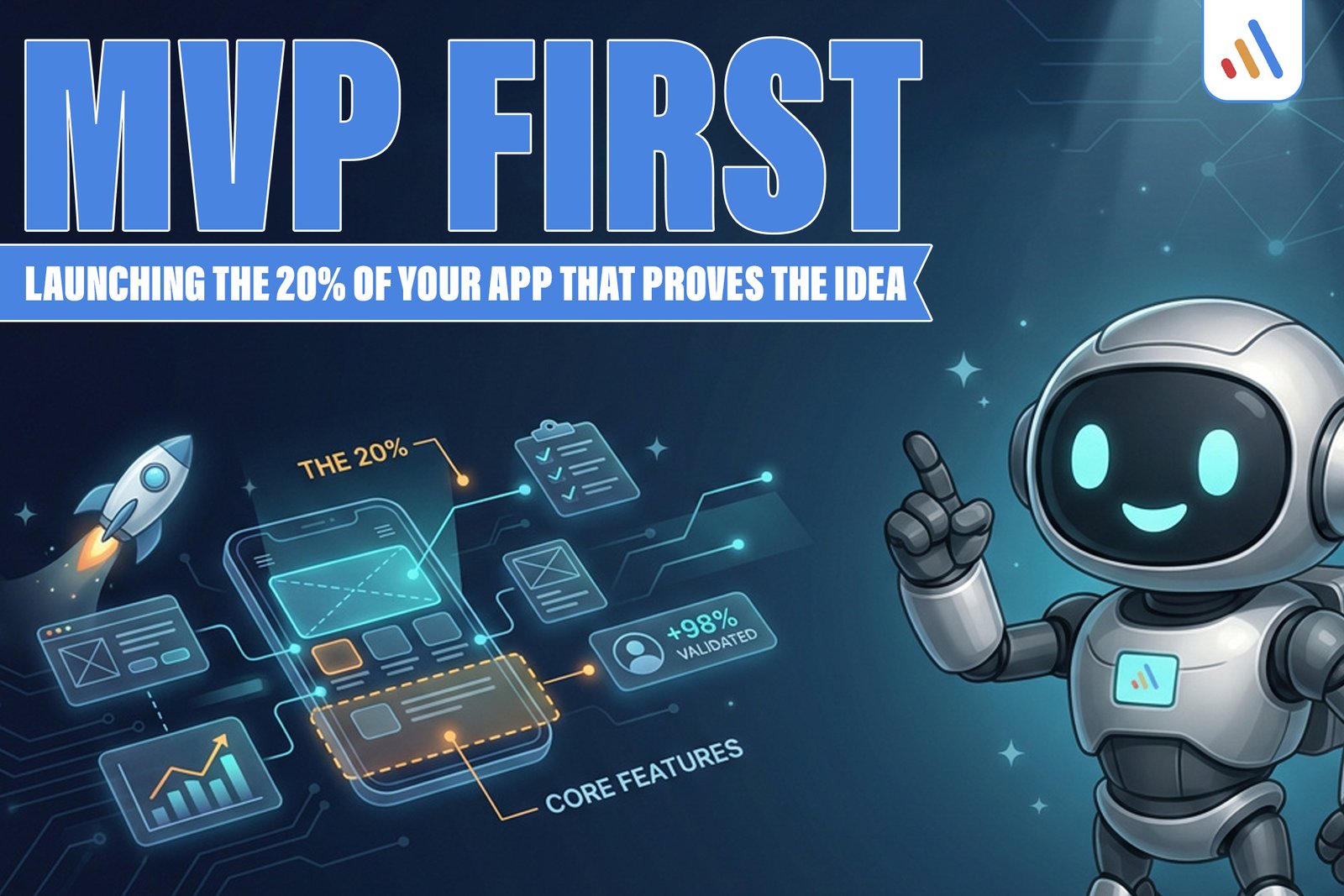
This is where an MVP development guide becomes useful. A Minimum Viable Product (MVP) is the smallest functional version of an application that allows you to test its core value with real users.
The goal is not to launch an unfinished product. It is to build enough functionality to test your most important business assumption without spending months developing features customers may never use.
The first 20% is a planning metaphor, not a fixed development formula. Here is how to identify that essential functionality, manage development costs, and launch a product that generates useful feedback.
1. What Is Minimum Viable Product Development?
Minimum viable product development means building the smallest usable version of a product that delivers its central value and allows a business to learn from real users.
An MVP is not simply a design prototype or a collection of unfinished screens. Users should be able to complete the primary task your application promises to solve.
Imagine you want to develop an appointment-booking application. Your complete vision might include customer profiles, service-provider dashboards, scheduling, payments, reminders, loyalty rewards, referrals, and AI recommendations.
But what if your main assumption is that customers want to discover available appointments and book them online?
Your first version might only need:
- Basic customer registration.
- Service listings.
- Available appointment slots.
- Appointment booking.
- Booking confirmation.
- A simple administrator interface.
These features can test whether customers actually use the booking service.
The remaining functionality can be introduced when user feedback and business requirements justify the investment.
2. How Do You Choose the First 20% of App Features?
The best way to prioritize MVP features is to identify the main customer problem, define the action that solves it, and remove functionality that does not directly support that action.
Start by answering three questions:
What problem are you solving? Describe the specific customer problem instead of using broad goals such as improving convenience.
Who experiences this problem? Identify your primary users and understand their current alternatives.
What action proves your solution works? This might be placing an order, booking an appointment, requesting a quotation, or completing a payment.
Then divide your proposed features into three groups:
| Priority | Purpose | Example |
| Must-have | Delivers the core value | Product search and ordering |
| Should-have | Improves the experience | Saved favorites |
| Later | Supports future expansion | Loyalty programs and AI recommendations |
Do not treat every stakeholder request as an MVP requirement. Each feature should support the primary user journey or address an essential operational requirement.
3. What Does the MVP App Development Process Look Like?
The MVP app development process turns a business idea into a testable application through discovery, prioritization, design, development, testing, and launch.
A practical process involves six stages:
Step 1: Validate the problem. Speak with potential users and investigate how they currently solve the problem.
Step 2: Define the core user journey. Map the essential actions users must complete to receive the product’s main benefit.
Step 3: Prepare requirements. Document essential features, user roles, integrations, platform requirements, and success criteria.
Step 4: Design the experience. Create wireframes and prototypes to test navigation and workflows before investing in full development. VCL UI/UX design services can support this stage.
Step 5: Develop and test. Build prioritized functionality and test critical workflows. Quality assurance and testing services should be included throughout development.
Step 6: Launch and measure. Release the MVP to an appropriate user group, monitor performance, and prioritize improvements based on actual behavior.
For a more structured starting point, read VCL guide to what happens in a software discovery call.
4. How Can You Validate a Startup Idea Before Building Everything?
You can learn how to validate a startup idea by testing the problem, customer interest, and willingness to use or pay for the proposed solution before committing to full development.
An application does not need to be completely built before you collect useful evidence.
Consider these approaches:
Customer interviews: Ask potential users about their current problems, workarounds, and purchasing decisions.
Landing-page testing: Present your product proposition and measure meaningful actions such as signups, inquiries, or demo requests.
Clickable prototypes: Let users explore a simulated interface and identify confusing workflows.
Concierge testing: Deliver part of the service manually to understand what customers value before automating everything.
MVP launch: Release a functional product that allows customers to complete the core journey.
Choose measurements that match your business model. For a booking application, completed bookings and repeat usage may matter more than registrations. For a B2B SaaS product, activated accounts and paid conversions may be more meaningful.
A large number of downloads does not automatically prove product-market fit. Measure behavior that demonstrates genuine customer value.
5. What Affects MVP Development Cost and Timeline?
MVP development cost depends on the number of essential features, application complexity, integrations, platform choices, design requirements, and testing effort.
The main cost factors include:
- Feature scope: More functionality requires additional design, development, and testing.
- Platform selection: Web, Android, and iOS development introduce different implementation and testing requirements.
- Backend complexity: Authentication, databases, permissions, and APIs affect development effort.
- Integrations: Payment gateways, maps, CRM systems, and external services introduce dependencies.
- UI/UX requirements: Complex workflows and custom interfaces require additional design work.
- Quality assurance: Device compatibility, integration testing, and regression testing must be included.
Do not estimate development cost by simply taking a percentage of your imagined full-product budget. Calculate the actual scope and technical requirements of the first release.
Timelines also vary. A focused application may take several weeks, while complex products can require several months.
VCL provides software development services for businesses planning custom applications and digital products.
6. A Real Example: Launching Core Features Before Expanding
VCL published Needu Feedu case study illustrates how a product can launch with core functionality before introducing additional features in subsequent phases.
Needu Feedu is an online food-ordering and delivery platform involving customers, restaurants, and delivery riders.
According to VCL published case study, the initial MVP included a customer website and Android application and launched in approximately 4–5 months. The iOS version and additional capabilities, including restaurant live chat and dynamic offers, followed in the next phase.
The same case study reports that the broader platform was delivered in approximately five months against a planned eight-month timeline.
This is a project-specific example, not a standard MVP development timeline. A booking application with limited functionality and a multi-user food-delivery platform have very different technical requirements.
The important lesson is that functionality can be phased according to business priorities rather than treating every planned feature as a launch requirement.
Read the complete Needu Feedu project case study.
7. When Should You Expand Beyond Your MVP?
You should expand beyond an MVP when actual usage, customer feedback, and business results provide a reasonable basis for investing in additional functionality.
Look for evidence such as:
- Users consistently completing the core workflow.
- Repeated requests for a particular missing feature.
- Customers returning to use the application.
- Willingness to pay for the value delivered.
- Operational bottlenecks that justify automation.
- Technical limitations affecting growth or reliability.
Avoid expanding the product simply because competitors offer more features.
Before approving the next development phase, ask whether the proposed feature solves a demonstrated problem, improves the core experience, or supports a measurable business objective.
A structured custom software development process helps turn early product feedback into a manageable development roadmap.
Conclusion: Prove the Idea Before Building the Entire Product
Your first application release should demonstrate why the product deserves to exist. It does not need every feature in your original vision.
Identify the main customer problem, prioritize the essential user journey, build a functional MVP, and measure how people use it.
Then make your next investment based on evidence rather than assumptions.
Frequently Asked Questions
What does MVP mean in app development?
MVP stands for Minimum Viable Product. It is the smallest functional version of an application that delivers its core value and allows a business to test its assumptions with real users.
How many features should an MVP have?
There is no fixed number. An MVP should include only the features needed to complete its primary user journey. The right scope depends on the problem, users, and product complexity.
How much does MVP app development cost?
The cost depends on features, design, platform selection, backend requirements, integrations, and testing. A focused web MVP and a multi-platform application with complex workflows have very different development requirements.
How long does it take to build an MVP?
A focused MVP may take several weeks, while more complex products can require several months. Estimates should account for discovery, design, development, integrations, testing, and launch.
Can an MVP be expanded into a full application later?
Yes. A well-planned MVP can provide the foundation for additional features, integrations, and platforms. However, the original architecture should account for realistic growth requirements to avoid unnecessary redevelopment.
Planning to turn your app idea into a working product?
VCL International helps businesses plan, design, develop, and test web and mobile applications with a focus on practical requirements and maintainable development.
Book a consultation