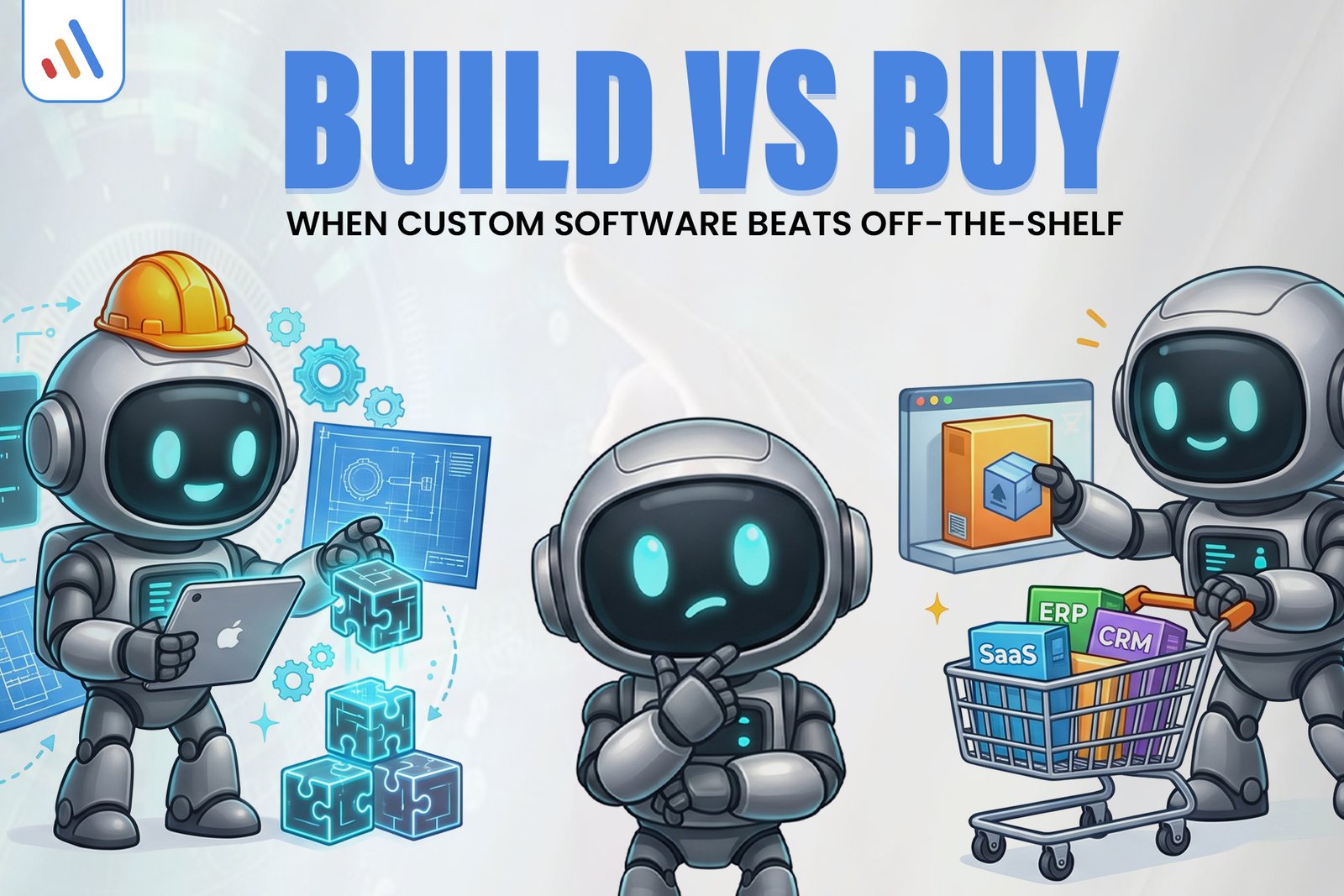
Choosing custom software vs off the shelf depends on how well an existing product supports your business operations. If standard features meet your requirements, buying ready-made software is usually the more practical choice. However, if essential workflows require specialized functionality, complex integrations, or capabilities that existing products cannot provide, custom development may be worth the investment.
For Pakistani SMEs, exporters, and growing enterprises, this decision can affect inventory management, accounting, sales, purchasing, and FBR-related workflows. The goal is not to build everything from scratch. It is to select the simplest solution that delivers the functionality your business actually needs.
1. Custom Software Development vs Ready-Made Software: What’s the Difference?
The main difference is that ready-made software serves a broad market, while custom software is developed around the specific requirements of an individual business.
Off-the-shelf software is an existing product that businesses purchase or subscribe to. Examples include accounting applications, CRM platforms, inventory management tools, and POS systems.
Custom software is designed around specific workflows, integrations, permissions, and reporting requirements. Businesses can determine which features an application needs and how different processes should work together.
For example, a small retailer might use an existing POS application to manage daily sales and stock. However, a distributor operating multiple warehouses may need a system connecting purchasing, stock transfers, sales, accounting, and reporting.
For a broader understanding of business resource planning, read our guide to ERP for SMEs Pakistan.
Neither option is automatically better. The right choice depends on operational complexity, available products, and long-term costs.
2. When Off-the-Shelf Software Is the Better Choice
Off-the-shelf software is generally the better choice when your business follows standard processes and an existing product already provides the features you need.
Its main advantages include:
- Lower initial investment: Subscription or licensing costs are generally easier to manage than a complete custom development project.
- Faster implementation: Existing applications can often be configured without building every feature.
- Ready-made functionality: Common features such as reporting, user management, and dashboards are usually available.
- Vendor maintenance: Providers typically handle product updates and technical improvements.
- Easier adoption: Employees may already be familiar with commonly used applications.
However, off-the-shelf software benefits and limitations should both be considered.
Problems can arise when a platform does not support your approval processes, inventory rules, reporting needs, or required integrations. Additional modules and premium subscriptions can also increase costs.
Practical rule: If an existing application meets approximately 80–90% of your requirements, investigate configuration and integration options before investing in a custom replacement. This is a planning guideline, not an industry benchmark.
3. When Custom Software Makes More Sense for Pakistani Businesses
Custom software makes more sense when existing applications cannot efficiently support essential business processes and their limitations create recurring operational problems.
Consider these examples relevant to businesses operating in Pakistan.
Specialized ERP and inventory workflows: An exporter may need one application to connect purchase orders, production updates, quality checks, shipping documentation, stock movement, and payment tracking. A customized ERP workflow may be appropriate when standard products cannot accommodate these requirements efficiently.
FBR-related invoicing: Businesses subject to applicable FBR digital invoicing requirements may need systems that connect sales records, accounting, and relevant invoicing processes. The exact obligations and technical integration requirements should be checked against current FBR guidance. Custom software alone does not establish tax compliance.
Local payment integrations: An ecommerce business may need to connect its store with payment services such as JazzCash or Easypaisa. This depends on the providers’ available integration facilities, account eligibility, and applicable commercial conditions.
Multi-branch operations: Businesses managing several outlets may need centralized stock visibility, branch-level reporting, and consistent approval workflows that existing applications cannot adequately provide.
These are situations where bespoke software solutions for businesses can offer meaningful operational value.
For businesses managing online stores and complex selling workflows, VCL e-commerce solutions provide relevant options, including Shopify, WooCommerce, and custom ecommerce development.
READY TO CONNECT YOUR ERP, POS & ACCOUNTING SYSTEMS?
Not sure whether to buy, integrate, or build? Get a practical assessment of your current systems, integration gaps, and the simplest solution for your business.
4. Custom Software Development Cost: What Should You Budget?
Custom software development cost depends on project scope, features, integrations, complexity, and ongoing support requirements.
There is no responsible universal PKR price range for every application. A basic internal tool and a multi-module ERP platform are fundamentally different projects. Quoting a fixed price without understanding the requirements could create unrealistic expectations.
Instead, compare these cost factors:
| Cost factor | Ready-made software | Custom software |
| Initial investment | License or subscription | Planning and development |
| Implementation | Setup and configuration | Design, development, testing |
| Integrations | Available connectors or APIs | Standard or custom connections |
| Customization | Limited by the vendor | Based on agreed requirements |
| Maintenance | Often included in subscription | Ongoing support and maintenance |
| Scaling | Depends on vendor plans | Depends on architecture and infrastructure |
For Pakistani businesses, currency also matters. A platform priced in USD may become more expensive in PKR when exchange rates or bank conversion charges change. Check billing currency, applicable taxes, renewal conditions, and additional user fees.
For custom projects, request a written estimate covering discovery, development, data migration, integrations, testing, employee training, hosting, and ongoing maintenance.
Compare total ownership costs over three to five years rather than choosing whichever option has the lowest initial price.
5. The Middle Option: Integration and Low-Code Platforms
A business does not always need to purchase an entirely new application or commission a fully custom system. Integrating existing tools or using a low-code platform can be a practical middle option.
For example, a company might already have suitable accounting software but struggle to connect it with inventory and sales applications. A custom integration can address the communication gap without rebuilding the accounting platform.
Low-code and no-code platforms offer another option. They allow teams to create basic applications and workflows using visual builders and prebuilt components.
However, evaluate their licensing costs, customization limits, data portability, security controls, and scalability before depending on them for critical operations.
For more guidance, read Connecting Your Tools: Business Software Integrations. It explains how businesses can connect ecommerce, accounting, CRM, courier, and messaging systems without replacing every application.
6. Ownership, Security, and Vendor Lock-In: What Businesses Should Check
Software selection should include ownership, security, and future flexibility because these factors can affect your ability to operate and maintain the system over time.
Before signing a development or subscription agreement, clarify:
- Data ownership: Who controls your business records, and can you export them in a usable format?
- Intellectual property: Who owns the source code, designs, and custom-developed components? Document these rights in the contract.
- Vendor lock-in: Can your business migrate to another provider without losing access to essential records?
- Security: Review access permissions, encryption, backups, logging, authentication, and incident-handling responsibilities.
- Compliance: Confirm which legal, contractual, and industry requirements apply to your business and how the selected solution supports them.
Custom software does not automatically guarantee better security or complete ownership. These protections depend on the architecture, contract, development practices, and ongoing maintenance arrangements.
Businesses developing web-based applications should also evaluate how the application will be hosted, maintained, and secured as usage grows. VCL web development services are relevant when the project involves custom web applications or modernizing an existing platform.
7. A Five-Step Build-vs-Buy Decision Framework
The best way to decide is to evaluate your actual business problem before selecting a technology solution.
Step 1: Identify the problem. Document where employees lose time, where records become inconsistent, and which processes require improvement.
Step 2: Compare existing products. Evaluate two or three relevant platforms, including their features, integration capabilities, pricing, and limitations.
Step 3: Separate essential features from preferences. Prioritize requirements that directly affect operations, reporting, customers, or financial control.
Step 4: Calculate long-term costs. Include subscriptions, development, integrations, migration, maintenance, and employee time.
Step 5: Select the simplest suitable solution. Buy when existing functionality is sufficient, integrate when applications need to communicate, and build when essential requirements cannot reasonably be met otherwise.
For larger organizations managing complex applications and operational systems, VCL enterprise solutions are another relevant reference when evaluating enterprise-level technology requirements.
Frequently Asked Questions
1. Is custom software better than off-the-shelf software?
Not always. Custom software is better when a business needs specialized workflows, integrations, or functionality unavailable in existing products. Ready-made software is generally more practical when standard features meet operational requirements.
2. How much does custom software development cost?
There is no fixed price because costs depend on application complexity, features, integrations, data migration, hosting, and maintenance. Businesses should request a scope-based estimate and compare the total cost of ownership against ready-made alternatives.
3. How long does custom software development take?
As a rough project-planning estimate, a small internal business tool may take 4–8 weeks, a moderately complex business application may take 2–4 months, and a multi-module enterprise platform may take 6–12 months or longer. Actual timelines depend on requirements, integrations, testing, and stakeholder approvals.
4. Can a business combine custom and off-the-shelf software?
Yes. Businesses can retain existing accounting, CRM, ERP, or POS platforms while developing custom integrations, dashboards, and additional applications. This hybrid approach can reduce unnecessary development while addressing important operational gaps.
5. Who owns custom software and its source code?
Ownership depends on the development agreement. Businesses should clearly establish intellectual property rights, source-code access, licensing terms, documentation, data ownership, and maintenance responsibilities before development begins.
Need Help Choosing the Right Software?
Choosing between ready-made software, integration, and custom development requires a clear understanding of your existing systems and business requirements. VCL International helps businesses assess their software needs, identify operational limitations, and evaluate suitable development approaches for ERP, POS, ecommerce, and other business applications.
Book a consultation