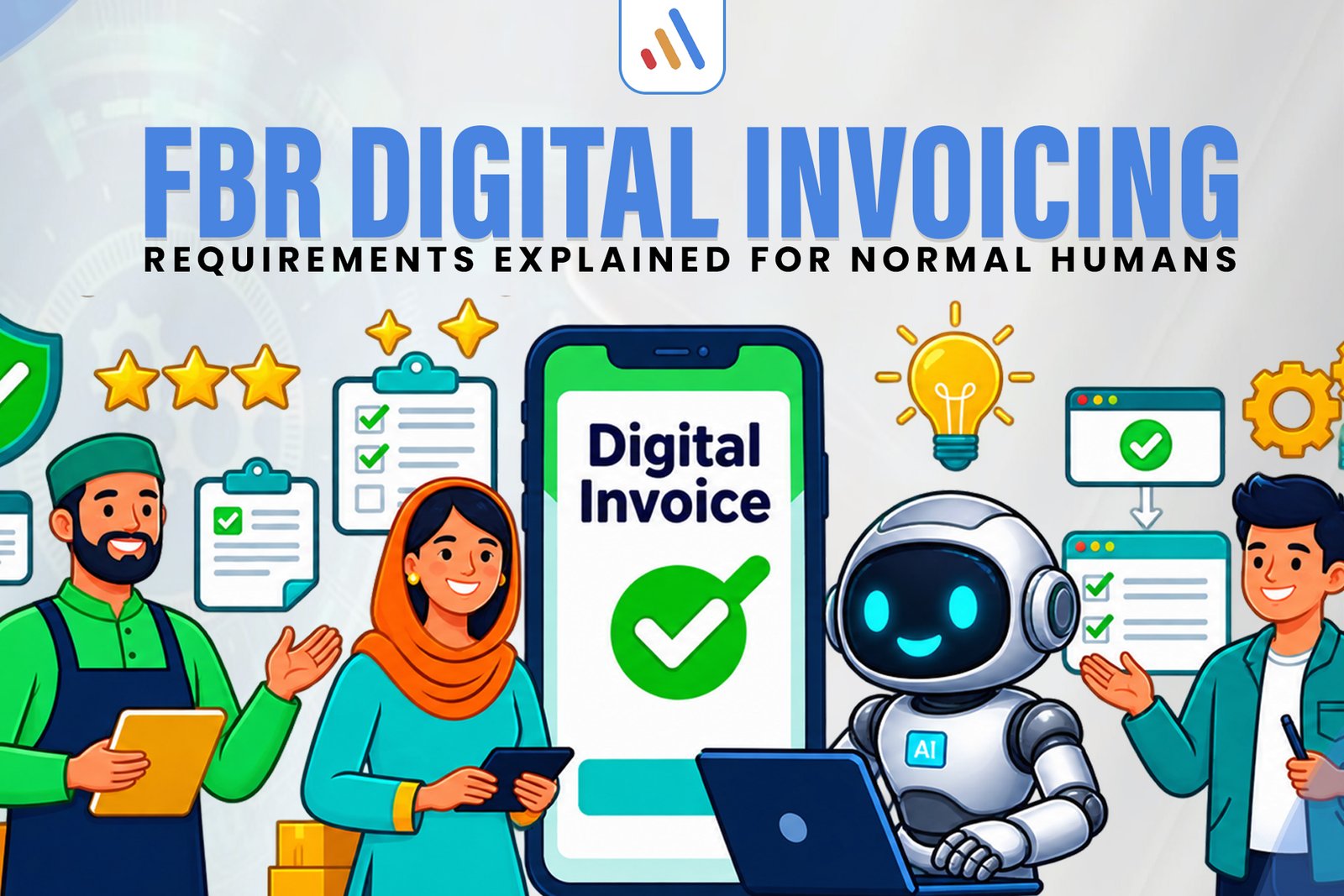
FBR digital invoicing is no longer just an IT upgrade for Pakistani businesses. It is a sales tax compliance requirement that affects how notified registered businesses generate, transmit, and maintain their electronic sales invoices.
In simple terms, instead of creating an invoice in your accounting software and keeping it only in your records, your integrated invoicing system must transmit the required invoice information to the Federal Board of Revenue (FBR) through an approved integration arrangement.
The FBR digital invoicing requirements apply to sales tax-registered persons covered by the relevant notifications. FBR’s SRO 1852(I)/2025 established a phased implementation schedule, while Sales Tax General Order No. 01 of 2026 introduced further integration flexibility and invoice amendment controls.
For business owners, the important questions are straightforward: Do you need to comply? What must your software do? And how can you avoid disrupting daily operations?
Who Needs to Follow FBR Digital Invoicing Requirements?
FBR digital invoicing requirements cover sales tax-registered persons specified under the applicable notifications, including companies, importers, individuals, and associations of persons.
The phased schedule under SRO 1852(I)/2025 covered the following categories:
- Public companies.
- Companies with annual sales turnover exceeding PKR 1 billion.
- Importers.
- Companies with turnover between PKR 100 million and PKR 1 billion.
- Companies with turnover up to PKR 100 million.
- Individuals and associations of persons with turnover exceeding PKR 100 million.
- Other registered persons.
The original schedule established implementation dates between November and December 2025.
Importantly, this is not a blanket requirement for every unregistered small business. Your actual obligation depends on your sales tax registration status, applicable notifications, and any relevant exemptions or extensions.
Businesses should confirm their current compliance position with a qualified tax professional rather than assuming that their turnover alone determines whether they must integrate.
What Does Real-Time FBR Reporting Actually Mean?
Real-time reporting means that your invoicing system electronically transmits the required sales invoice information to FBR’s computerized system as part of the invoicing process.
Think of a normal retail transaction.
A customer purchases products worth PKR 25,000. Your POS generates the invoice, calculates the applicable sales tax, and sends the required information through the integrated system.
FBR processes the submitted information and the invoice can receive its unique identification and verification details.
This is different from manually preparing invoices at the end of the day and uploading a spreadsheet later.
According to FBR’s technical and legal framework, an integrated person must issue a real-time verifiable electronic sales tax invoice for every taxable supply covered by the requirements.
The timing of supply also matters. FBR’s FAQ explains that digital invoices should be issued at the time of supply, meaning receipt of payment or delivery of goods, whichever occurs earlier, under the applicable Sales Tax Act provisions.
What Information Must an FBR Digital Invoice Include?
An FBR-compliant electronic invoice must contain prescribed information that identifies the seller, buyer, transaction, and applicable tax details.
Under the Sales Tax Rules, 2006, the required invoice particulars include:
| Invoice information | What it means |
| FBR invoice number | Unique invoice identification |
| QR code | Invoice verification |
| Seller details | Business name, address, and registration number |
| Buyer details | Recipient information where applicable |
| Invoice date | Date of issue |
| Tax period | Relevant reporting period |
| Product description | Details of supplied goods |
| Quantity | Units sold |
| Value excluding tax | Taxable value |
| Sales tax rate | Applicable rate |
| Sales tax amount | Calculated tax |
| HS code | Relevant product classification |
| Unit of measurement | Product measurement details |
Other applicable fields can include discounts, extra tax, further tax, federal excise duty, and relevant SRO references.
For example, a distributor selling 100 units of a product must ensure that the invoice contains the correct description, quantity, applicable classification, and tax calculations.
The software should not simply generate a PDF and label it an FBR invoice. FBR distinguishes structured electronic invoices from scanned or copied paper invoices.
How Does ERP or POS Integration With FBR Work?
ERP or POS integration connects your existing invoicing system with FBR’s computerized platform through an FBR-approved licensed integrator.
The integration allows businesses to continue using their operational software while transmitting the required invoice information electronically.
A typical implementation involves five steps.
1. Review Your Existing Software
Identify whether your business generates invoices through an ERP, POS, accounting platform, or custom invoicing application.
Check whether the software supports the necessary integration and invoice data requirements.
2. Select a Licensed Integrator
FBR requires notified registered persons to use a licensed integrator for the prescribed integration process.
PRAL also acts as a licensed integrator and provides integration services free of cost on demand, according to FBR’s published FAQ.
Always verify the current license status using FBR’s official list of licensed integrators.
3. Prepare Your Invoice Data
Your software should maintain accurate product descriptions, quantities, tax rates, HS codes, customer details, and other applicable information.
Poor product data can create validation errors even when the API connection works correctly.
4. Complete Integration and Testing
The licensed integrator works with your invoicing software to establish the required connection.
Testing should cover invoice submission, validation responses, successful reporting, and error handling.
5. Monitor Daily Invoice Reporting
Once integration is operational, monitor rejected invoices, transmission failures, and reconciliation differences.
A successful software connection does not eliminate the need for ongoing operational and tax checks.
For businesses managing multiple departments, suppliers, and sales channels, a properly designed ERP system for SMEs in Pakistan can help connect invoicing with wider financial and inventory operations.
What Happens When an Invoice Contains an Error?
Invoice corrections require particular attention because an issued electronic invoice cannot simply be edited whenever someone notices a mistake.
Under Sales Tax General Order No. 01 of 2026, issued on March 30, 2026, an integrated person may cancel, delete, or edit a valid electronic sales tax invoice generated due to a bona fide mistake through the Board’s computerized system within 72 hours of generation.
After 72 hours, prior approval from the concerned Commissioner Inland Revenue is required, subject to the applicable conditions.
This makes invoice validation important before submission.
Recommended operational controls include:
- Validate product and tax information before issuing invoices.
- Restrict invoice editing permissions.
- Maintain an audit trail of invoice changes.
- Monitor failed submissions.
- Train finance and billing teams on correction procedures.
These are implementation recommendations, not additional statutory requirements in themselves.
Common FBR Digital Invoicing Mistakes Businesses Should Avoid
Many implementation problems arise because businesses treat digital invoicing as a simple software installation instead of a complete operational process.
Watch out for these mistakes:
Choosing software without checking integration capability: A billing application may generate invoices but still lack the required FBR integration support.
Incorrect HS codes and product information: Incorrect classifications can create tax calculation and reporting problems.
Ignoring rejected invoices: A failed transmission should not be treated as a successfully reported invoice.
Allowing unrestricted invoice editing: This can create problems under the applicable 72-hour correction procedure.
Ignoring online sales channels: Businesses should assess whether their e-commerce websites, applications, and marketplaces require registration or integration under the applicable rules.
For companies handling online orders, VCL e-commerce solutions can support the development of connected commerce and invoicing workflows.
Frequently Asked Questions
1. Is FBR digital invoicing mandatory for all businesses in Pakistan?
It is mandatory for sales tax-registered persons covered by FBR’s applicable notifications. Businesses should verify their registration status, applicable category, and any exemptions or extensions.
2. Do I need an ERP system to integrate with FBR?
No. FBR’s framework allows integration through POS, ERP, or other electronic invoicing software. The system must meet the applicable technical requirements and use the prescribed integration arrangement.
3. Can I use PRAL for FBR digital invoicing integration?
Yes. FBR identifies PRAL as a licensed integrator and states that it provides integration services free of cost on demand. Other currently licensed integrators may also be available.
4. Can an FBR digital invoice be edited after submission?
Under STGO No. 01 of 2026, cancellation, deletion, or editing of a valid electronic sales tax invoice generated due to a bona fide mistake is allowed through the Board’s computerized system within 72 hours. Changes after that period require prior approval from the concerned Commissioner Inland Revenue.
5. Does FBR digital invoicing apply to online and export sales?
Online sales should be assessed under the applicable integration rules, including provisions covering online sales and marketplaces. FBR’s FAQ also states that digital invoices are required for sales reported in Annexure-C of the sales tax return, including applicable export sales. Confirm the treatment of your specific transactions with a tax professional.
Final Thoughts: Make FBR Compliance Part of Your Business Workflow
FBR digital invoicing does not have to become a daily operational headache. The key is understanding your compliance obligations, preparing accurate invoice data, selecting an appropriate licensed integrator, and connecting the process with your existing business software.
For Pakistani SMEs, retailers, manufacturers, and exporters, this is also an opportunity to improve financial visibility and reduce manual invoice handling.
A properly planned ERP or POS integration can make reporting more consistent while helping finance and operations teams work from connected business information.
Ready to Connect Your Business Software With FBR?
Don’t wait for invoice errors or integration problems to interrupt your operations. VCL International helps businesses plan and develop software solutions that connect invoicing, ERP, POS, and business workflows.
Book a consultation