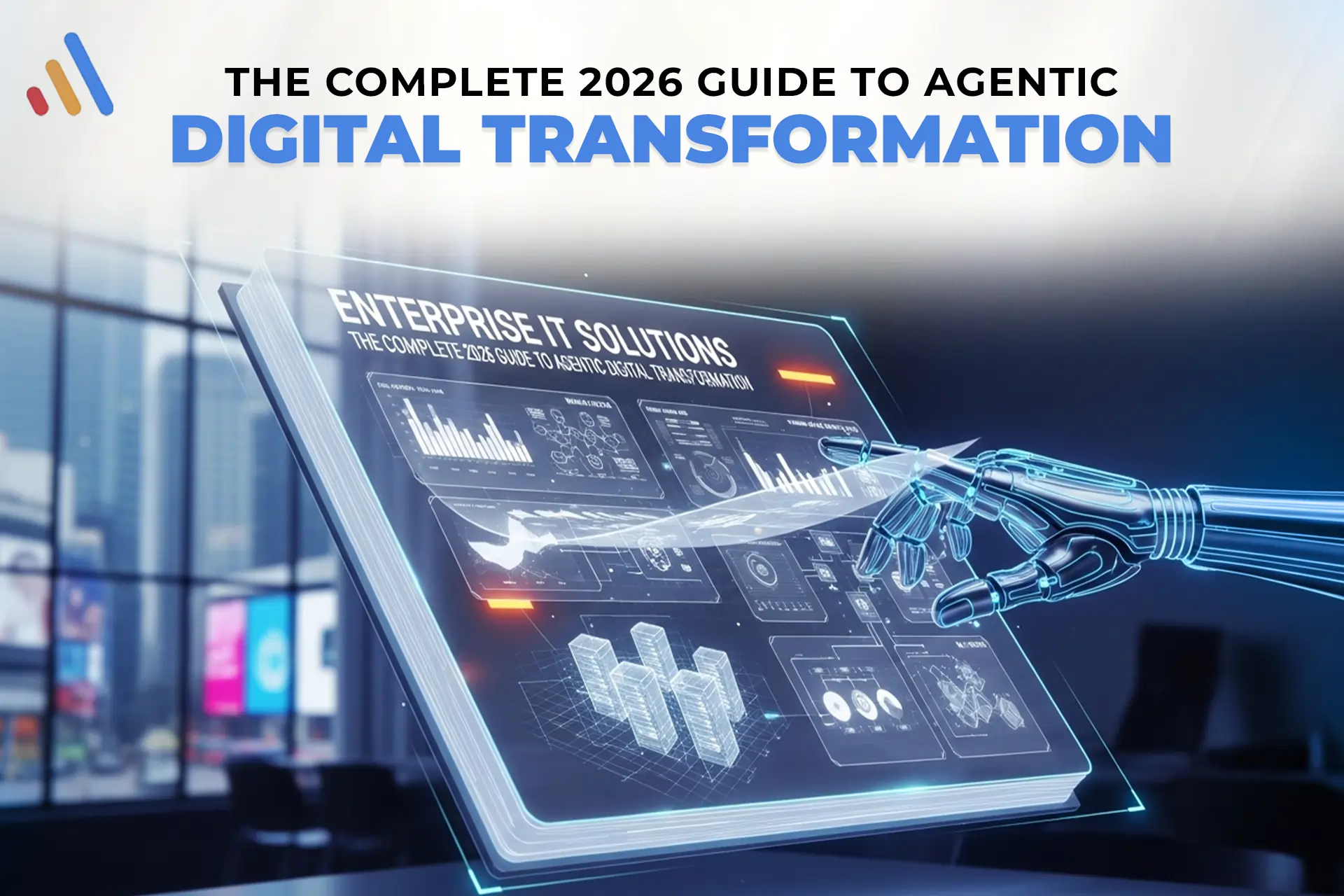
Enterprise IT solutions have evolved from static software platforms into adaptive, AI-driven ecosystems that serve as the autonomous backbone of modern organizations. In 2026, these systems don’t just connect business functions, they actively orchestrate operations, learn from patterns, and execute complex workflows with minimal human intervention .
The paradigm has shifted dramatically. Where previous generations required manual coding and configuration, 2026’s solutions operate on intent-driven development: business leaders articulate desired outcomes, and AI autonomously delivers, integrating and maintaining systems behind the scenes . This represents a fundamental change from “writing code” to “expressing intent.”
Today’s enterprise solutions encompass several integrated categories:
| Solution Category | 2026 Capabilities | Business Impact |
| Agentic Enterprise Search | AI agents that retrieve information AND execute cross-system workflows | Reduces cognitive load; automates action after discovery |
| Intelligent Operations (AI Ops) | Self-healing, self-optimizing operational ecosystems | Transforms operations from cost centers to value engines |
| Enterprise Mobility Management | AI-augmented security for distributed workforces | Protects sensitive data across any device, any location |
| Cloud 3.0 Infrastructure | Hybrid, multi-cloud, and sovereign AI-ready architectures | Enables AI scalability while maintaining data sovereignty |
| Agent-Native Security | Identity and access management for human AND digital workers | Secures the emerging “digital workforce” of AI agents |
Why 2026 Is “The Year of Truth for AI”
After years of fragmented pilots and inflated expectations, 2026 marks the shift from proof-of-concept to proof-of-impact . Organizations are no longer experimenting with AI, they’re embedding it into the very fabric of enterprise decision-making. This transformation demands not just technology, but governance and cultural readiness.
The Crisis of Enterprise Knowledge
Despite technological advances, workers still struggle with information fragmentation. Enterprise knowledge is scattered across dozens of disconnected tools: Slack, Salesforce, Jira, Notion, SharePoint, and proprietary databases . Traditional search fails because it lacks:
- Context-awareness: results don’t account for role, project, or intent
- Actionability: search returns links, not answers or next steps
- Permission enforcement: sensitive data surfaces incorrectly
- Multi-system integration: each tool requires separate search
The Cost: Employees lose approximately 2.5 hours daily searching for information, costing organizations around $4,500 per employee annually . In 2026, this inefficiency is no longer acceptable.
The AI Implementation Reality Check
While 37% of organizations report enterprise-wide adoption of generative AI and 17% are actively piloting, only 7% have no plans for Gen AI integration . However, AI projects still fail without proper data foundations. The key differentiator in 2026 isn’t having AI, it’s having AI-ready data infrastructure that can support autonomous, agentic workflows .
Core Components of 2026 Enterprise Solutions
1. Agentic Enterprise Search (The New Standard)
2026’s enterprise search has transcended simple retrieval. AI agents now combine natural language processing, retrieval-augmented generation (RAG), and workflow automation to not only find information but act on it .
Key 2026 Capabilities:
| Feature | Function | Business Value |
| Cross-System Orchestration | Connects to Slack, Jira, Salesforce, Notion, SharePoint simultaneously | Eliminates app-switching friction |
| Agentic Workflows | Creates tickets, updates CRM records, drafts reports from natural language queries | Transforms search into action |
| Multi-LLM Routing | Intelligently selects optimal AI models for specific tasks | Maximizes accuracy and cost-efficiency |
| Enterprise Agentic Memory | Persistent context across sessions; agents learn from past interactions | Enables true digital employees, not just chatbots |
| Citation-Backed Responses | Every answer links to source documents | Ensures compliance and trust |
Market Projection: Enterprise search is forecast to reach $8.70 billion by 2030, with conversational and NLP engines growing at 21.20% CAGR . By 2027, Gartner predicts the majority of enterprises will deploy generative AI solutions connected to internal knowledge systems .
2. Intelligent Operations (AI Ops)
Monolithic enterprise backbones have evolved into living ecosystems of intelligent, modular, continuously learning applications . These systems blend human oversight with autonomous AI agents, putting adaptive processes at the core of business value creation.
2026 Innovations:
- Self-healing infrastructure: Systems automatically detect and resolve issues before business impact
- Predictive resource allocation: AI anticipates demand patterns and scales resources proactively
- Autonomous process optimization: Workflows continuously improve based on outcome data
3. Cloud 3.0: All Flavors of Cloud
Cloud has entered its third evolution. After migration (Cloud 1.0) and cost optimization (Cloud 2.0), Cloud 3.0 is the operational backbone for AI . Key characteristics:
- Hybrid and sovereign cloud models dominate, driven by data sensitivity and fine-tuning requirements for proprietary AI models
- Edge computing integration processes data closer to sources for low-latency AI inference
- Cloud as active enabler rather than passive infrastructure, ensuring portability and sovereignty
Market Data: Cloud deployments represented 82.14% of the business software market in 2025, forecast to grow at 12.96% CAGR through 2031 .
4. Agent-Native Security Architecture
With the rise of AI agents, security has shifted from protecting human users to orchestrating digital workers . 2026’s critical security layers include:
Table
| Security Layer | Purpose | 2026 Innovation |
| Identity for Agents | Badge and keys for digital workers | Platforms like Keycard and Fabrix provide least-privilege access for AI agents |
| MCP Security | Secures Model Context Protocol connections | Prevents excessive tool access by autonomous agents |
| Agentic Pen Testing | Continuous AI-driven security validation | Agents like TerraSecurity and XBOW probe defenses daily, not annually |
| Browser Security 2.0 | Protects AI workloads in browser environments | Solutions like Island rebuild browsers for agent-native operations |
Measurable Business Benefits: 2026 Data
Organizations leveraging integrated enterprise solutions report quantifiable competitive advantages:
Productivity & Efficiency
- Decision Velocity: Companies with strong knowledge management systems make critical decisions 60.5% faster than those without integrated solutions
- Development Acceleration: Low-code and no-code platforms reduce application development time by 50-90%
- Sales Performance: AI-augmented sales processes deliver up to 50% increase in leads and appointments, with high-performing reps 1.9x more likely to use AI
Financial Impact
- Automation ROI: Robotic Process Automation (RPA) delivers up to 200% ROI in the first year alone
- Revenue Growth: Organizations leveraging integrated data analytics are 23 times more likely to acquire new customers and 19 times more likely to achieve profitability
- Market Expansion: The global digital transformation market is projected to reach $3.4 trillion by 2026
Operational Resilience
- Crisis Preparedness: Companies that led in digital transformation pre-2020 were 67% more resilient during subsequent disruptions
- Competitive Agility: By 2024, 60% of mainstream companies listed “becoming a composable business” as a strategic goal, enabling them to outpace competitors by 80% in implementing new features
Real-World Implementation Scenarios: 2026
Scenario 1: Global Financial Services, Agentic Operations
A multinational bank deployed agentic enterprise search across its trading, compliance, and customer service divisions. The AI agents don’t just retrieve client records, they autonomously:
- Generate compliance reports by querying transaction databases and regulatory documents
- Draft personalized client communications based on portfolio performance
- Create and route support tickets with full context
Result: 40% reduction in manual research time, 99.5% compliance audit accuracy, and $12M annual savings in operational costs.
Scenario 2: Healthcare Network: Intelligent Operations
A hospital system implemented AI Ops for patient flow management, resource allocation, and predictive maintenance of medical equipment. The system:
- Predicts patient admission surges 48 hours in advance
- Automatically adjusts staffing schedules and bed allocations
- Identifies equipment failures before they occur
Result: 25% improvement in patient throughput, 60% reduction in equipment downtime, and $8M annual operational savings.
Scenario 3: Manufacturing: Cloud 3.0 & Edge AI
A manufacturer integrated hybrid cloud infrastructure with edge computing for real-time quality control. Computer vision AI at the edge inspects products instantly, while cloud-based analytics optimize supply chains globally.
Result: Defect detection improved by 300%, supply chain costs reduced by 18%, and time-to-market accelerated by 22%.
Implementation Strategy for 2026
Phase 1: Foundation: AI Data Readiness
Before deploying agents, organizations must ensure data is AI-ready . This means:
- Unified data pipelines: Continuous, reliable data flows using platforms like Syncari and Keboola
- Data quality automation: AI-driven cleansing and governance
- Permission architecture: Role-based access that agents can interpret and enforce
Phase 2: Pilot: Agentic Workflows
Start with high-impact, low-risk use cases:
- IT Service Management: Auto-classify incidents and surface resolution recommendations
- Sales Operations: Draft follow-up emails and update CRM records from call transcripts
- HR Onboarding: Guide new hires through paperwork and system access provisioning
Phase 3: Scale: Intelligent Operations
Transform entire operational domains:
- Deploy Agent Orchestration platforms (Sentari, etc.) to manage multi-agent workflows
- Implement Enterprise Agentic Memory (Supermemory, Pryon) for persistent agent learning
- Establish Agent Observability (The Context Company, Lucidic) to trace and debug agent decisions
Critical Success Factors
Table
| Factor | 2026 Approach | Common Pitfall |
| Change Management | Treat AI as “digital employees” requiring onboarding and management | Viewing AI as just another tool |
| Governance | Establish “Human-AI chemistry”, clear oversight and escalation paths | Unclear accountability for AI decisions |
| Skills Development | Reskill toward systems thinking and AI orchestration | Focusing only on technical coding skills |
| Vendor Selection | Prioritize agent-native platforms over retrofitted legacy solutions | Choosing vendors based on brand recognition rather than agentic capabilities |
2026 Trends Defining the Future
1. AI Is Eating Software
The software development paradigm has fundamentally shifted. Developers now articulate desired outcomes, and AI autonomously delivers, integrates, and maintains systems . This moves the competitive edge from coding proficiency to orchestration and governance mastery.
2. The Rise of Agent-Native Stacks
Organizations are building infrastructure specifically for AI agents, including:
- Agent browsers (BrowserBase, Kernel) for autonomous web navigation
- Agent identity platforms for secure digital worker management
- Agent orchestration layers for coordinating multi-agent workflows
3. Tech Sovereignty 2.0
Tech sovereignty has returned to the top of the agenda, but the 2026 approach emphasizes resilient interdependence, balancing open collaboration with strategic self-reliance . Success depends on designing systems that remain globally connected yet controllable, embedding sovereignty principles into architecture rather than pursuing isolationist strategies.
4. Converged Platforms
The distinction between AI, data, security, and cloud platforms is blurring. Platform convergence is one of the top 10 enterprise technology trends for 2026, as organizations seek unified solutions that span traditional categories .
5. Continuous Compliance
Compliance is becoming a state of being, not a quarterly panic attack . Platforms like Zania and NormAi use AI to map controls to evidence continuously, making organizations audit-ready 24/7 .
Implementation Challenges in 2026
The Agent Sprawl Problem
Organizations face “agent sprawl” where too many bots have token access with unclear ownership . Agents often inherit broad permissions because scoping access for dynamic tasks is complex.
Solution: Implement Identity for Agents platforms that provide badge-and-key systems for digital workers, enabling least-privilege access and full audit trails .
The Memory Gap
Most early AI agents were stateless amnesiacs, resetting every session and losing context . This creates fragmented knowledge and inconsistent behavior.
Solution: Deploy Enterprise Agentic Memory solutions that provide persistent context layers, enabling agents to learn from past interactions and mistakes .
Human-AI Chemistry
The biggest challenge isn’t technical, it’s organizational. 2026 requires “Human-AI chemistry”: the art of blending human judgment with autonomous AI action . This demands new governance models, escalation procedures, and cultural adaptation.
Conclusion:
Enterprise IT solutions in 2026 have transcended their origins as productivity tools. They are now the autonomous nervous system of competitive organizations, self-healing, self-optimizing, and increasingly self-directing.
The data is unequivocal: organizations with integrated, agentic systems make decisions 60% faster, achieve 200% first-year automation ROI, and are 23 times more likely to acquire new customers .
Frequently Asked Questions:
Q: What’s the difference between 2024’s enterprise search and 2026’s agentic search?
Traditional enterprise search retrieved documents. 2026’s agentic search retrieves AND acts, creating tickets, updating records, drafting reports, and executing cross-system workflows from natural language commands .
Q: What is “Enterprise Agentic Memory” and why does it matter?
It’s persistent storage for AI agent cognition. Without it, agents reset every session like amnesiac employees. With it, they learn from past interactions, building institutional knowledge that improves over time .
Q: How do we secure AI agents differently from human users?
Agents require identity platforms (like Keycard or Fabrix) that provide badges, keys, and least-privilege access specifically designed for non-human workers. You must be able to identify, authenticate, and audit every agent action .
Q: What’s the biggest mistake organizations make in 2026 implementations?
Treating AI as a tool rather than a digital workforce. Agents need onboarding, management, orchestration, and governance, just like human employees. Organizations that master “Human-AI chemistry” win; those that don’t struggle with sprawl and shadow AI .
Q: Is cloud still relevant in 2026, or is everything edge?
Cloud 3.0 is more relevant than ever, but it’s evolved. Organizations now use hybrid, multi-cloud, and sovereign cloud models, not as exceptions, but as standard architecture for AI scalability and data sovereignty .